
Bonn Bulletin: Finance row threatens to scupper work on adaptation goal
One of the key tasks for this year’s Bonn talks is to agree on how to put into practice the indicators for the Global Goal on Adaptation, which were hurriedly redrafted by governments at the end of COP30 after years of painstaking work by experts.
Making them usable involves drawing up contextual information (metadata) and methodologies for the indicators. They include metrics such as the number of people per 100,000 who are covered by early warning systems or the proportion of the population vulnerable to climate change that have access to mental health and psychosocial support.
There has been some arguing in Bonn over who should do this work. More government negotiators or more technical experts? Should there be an Indigenous Peoples representative on the taskforce?
But the main sticking point – and the one that could prevent any agreement before the talks end today – is, as usual, finance. Developing countries are united in demanding that the COP30 agreement to triple adaptation finance by 2035 be referenced in the GGA agreement here in Bonn. Most developed countries are opposed, having long wanted to keep the GGA and finance separate.
New data shows rich nations likely missed 2025 goal to double adaptation finance
Although the tripling goal has already been agreed, Bethan Laughlin from the Zoological Society of London said that restating in the GGA text here “sends an important political signal on the need to address the widening adaptation finance gap, and helps maintain pressure on developed countries to scale up their support”.
One of the concerns some developing countries had about the GGA indicators agreed at COP30 is that they will be blamed if they fail to meet them. Rich nations, on the other hand, likely fear that, if finance is linked to the GGA and they fail to triple it, it is they who will be held responsible for a lack of progress instead.
At the time of publication, governments were holding informal consultations to see if they could find a way forward. But, given that on Wednesday night they could not even agree on whether a new draft text should form a basis for negotiations, the odds of overcoming their differences in the remaining hours look slim.
Nations agree to disagree on Adaptation Fund board seats
The risk that much-needed funds for adapting to climate change lie out of reach in inaccessible bank accounts while the world gets warmer has grown, after governments failed in Bonn to resolve an ongoing row over how to categorise richer and poorer nations.
The June talks aimed to agree on transitioning the UN’s Adaptation Fund to “exclusively” serve the Paris Agreement, rather than also serving the older Kyoto Protocol. That decision could then have been officially rubber-stamped early on at COP31.
But the seemingly straightforward decision has been complicated, as Global North and South countries could not agree on how to formally define each other.
Less wealthy nations want seats on the Adaptation Fund’s board to continue to be split between Annex 1 and non-Annex 1 countries as they are now. Annex 1 is a list of wealthier countries drawn up by governments in 1992.
Those Annex 1 countries agree that board seats should be split but want the two categories to be called “developed” and “developing”, which are less rigid categories and can evolve in line with countries’ changing economic status.
Bonn Bulletin: Adaptation Fund stalemate puts people at risk, says head
The underlying issue is that the European Union and others want bigger and richer developing countries like China and Saudi Arabia to be given responsibility for paying climate finance alongside traditional donor governments. China, in particular, has fiercely resisted this, with backing from other non-Annex 1/developing countries.
According to draft conclusions for Bonn, although there is alignment on the less controversial issues of updating the fund’s terms and conditions to serve the Paris Agreement and the timing of a regular review of its work, governments will agree not to agree on the Adaptation Fund board’s composition and will pick up the matter again at COP31. Often, major compromises can only be made by the environment ministers who attend COPs, not the more junior officials who come to Bonn.
But this delay raises the risk that countries do not fully agree to transition the fund at COP31. That would mean the fund cannot access money raised from a 5% tax on all carbon credits – other than those based in the most-vulnerable nations – from the UN’s new Article 6.4 carbon trading mechanism.
This could amount to millions of dollars lying idle as adaptation needs rise. The fund’s head Mikko Ollikainen told Climate Home News on Tuesday in Bonn that this “will lead to loss and damage and that’s going to be even more costlier than adaptation – and the cost will be borne by people who have done least to cause this problem who typically don’t have social safety networks to support them”.
US exit from UNFCCC leaves hole in budget
Even though the United States didn’t participate in the Bonn talks, Washington’s decisions still loomed large over the discussions. Last January, the Trump administration decided to withdraw not only from the Paris Agreement – as in his first term – but also from the UN Climate Convention (UNFCCC).
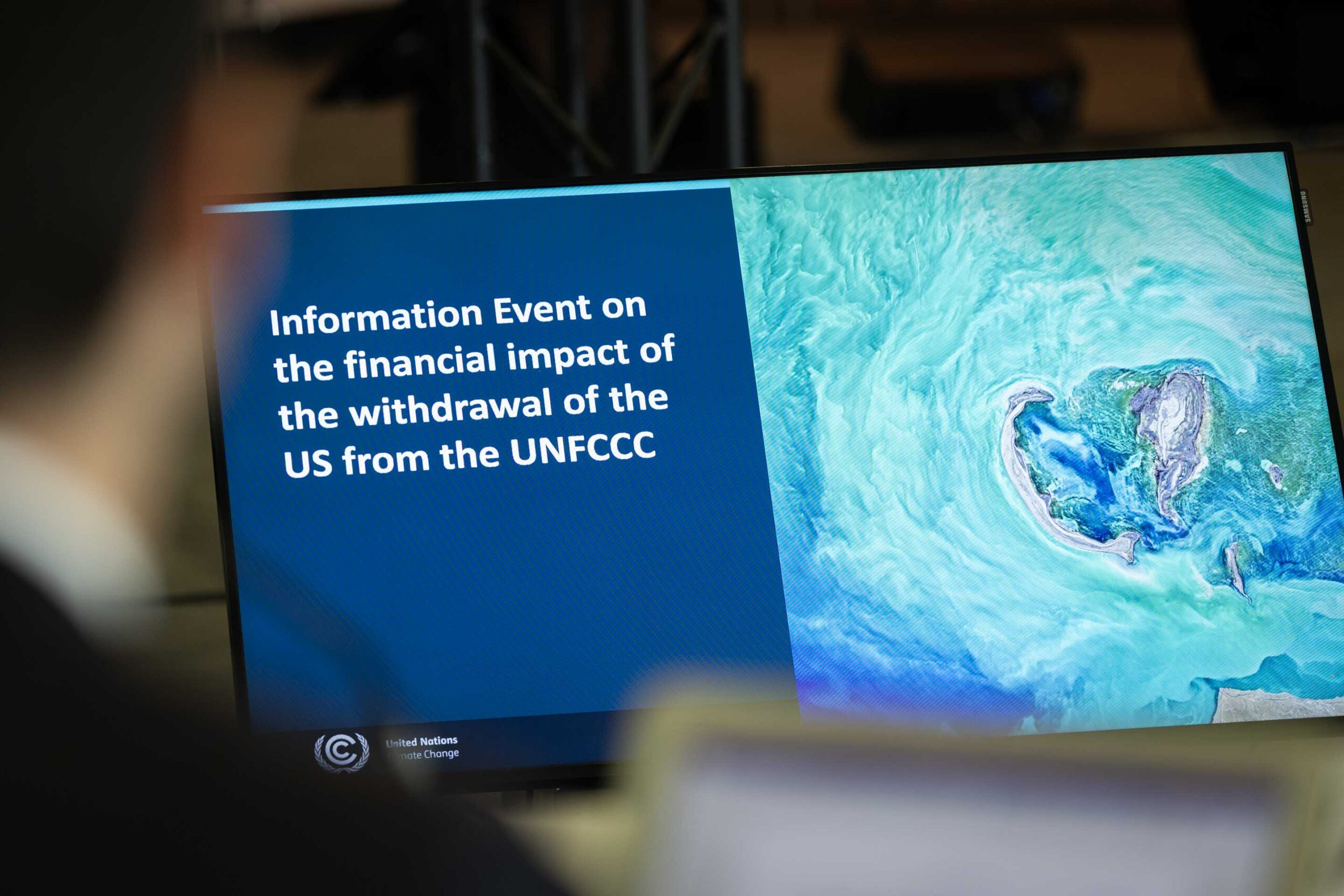
The move will have a significant impact on the financing of the Bonn-based body and the myriad of activities in its ever-growing agenda, according to a brief information event held by the secretariat at the Bonn climate talks.
SBI Chair Julia Gardiner mentioned that the US withdrawal could limit the Secretariat’s ability to support countries, especially developing ones, in advancing climate action.

The US withdrawal formally takes effect on February 27 2027, so the withdrawal will have a direct impact on the next budget for 2028-2029, the UNFCCC secretariat said in the briefing. Washington is currently the single largest financial contributor to the convention. Its withdrawal will cut core contributions by 21% or EUR16.9 million over the two-year period.
Who will step in to fill the gap?
When Trump pulled the US out of the Paris Agreement soon after his inauguration in January 2025, US billionaire Michael Bloomberg promised to cover the shortfall left by Washington, together with other unnamed funders. Since then, his namesake philanthropy has given the UN climate change body at least $17 million, according to UNFCCC documents.
But Bloomberg or any other non-state donor could only contribute to the budget for supplementary activities, not to the core budget on which, for example, the holding of the Bonn meetings or any event mandated by governments depends, Tobias Holle, managing director of Shifting Advocacy, told Climate Home News.
The money in the supplementary activities budget can not be used to cover core budget needs, he explained, adding that funding for that can only come from governments.
After Trump’s pullback, Bloomberg promises to fill US funding gap to UN climate body
According to the US-based think-tank Center for Climate and Energy Solutions, “one scenario will be that, with the budget gap equally redistributed among current contributors, other Parties [like China, Japan, Germany, UK, France] would have to increase their contributions by about 27% to maintain the current budget.”
For Holle, even if the budget shortfall represents a challenge, “this situation could be an opportunity” to advance on the reform of the UN climate process and improve the joint work of the climate convention with other treaties like those on biodiversity and desertification.
The UN will continue consultations with countries and present its proposed 2028-2029 budget in April 2027. At the time of publication, the UN climate body had not commented on the issue.
The post Bonn Bulletin: Finance row threatens to scupper work on adaptation goal appeared first on Climate Home News.