


Waiting at Davos: U.S. Allies Wrestle with Trump’s Threats to Greenland
emactaggart
Waiting at Davos: U.S. Allies Wrestle with Trump’s Threats to Greenland
What is happening?
Donald Trump is on his way to the World Economic Forum in Davos, and Greenland is on the agenda. On 4 January, President Donald Trump created a major crisis with Washington’s closest allies in Europe by returning to a theme he had raised before: insisting that the United States ought to and will acquire the island, which is an autonomous territory of the Kingdom of Denmark.
While many once dismissed mentions of such territorial designs as grandiose musings that would surely dissipate, Trump’s thirst for Greenland now risks upending the NATO alliance and, with it, the foundations of Europe’s security. With Trump’s threats to Denmark (he has refused to rule out use of force to get his way) augmented by plans to impose tariffs on countries standing with it, traditional U.S. allies are now facing an immediate question with huge strategic implications: how to deter and constrain Washington while managing the challenges presented by Russia and its continuing war in Ukraine, something on which they had hoped to have continuing U.S. help. Whether Trump climbs down from his threats in Davos or leans into them is simply unknowable until he speaks later today. But one way or the other, U.S. allies cannot escape the challenges posed by the profound upheaval Trump has caused in the international system of laws, institutions and alliances that the U.S. helped construct in the decades following World War II.
Trump’s motivations in seeking to obtain Greenland remain muddled. He suggested purchasing the island during his first term in office only to be rebuffed by Denmark. He began his second term with an inauguration address in which he vowed that the U.S. would once again become a country that “expands its territory” and soon thereafter talked again of somehow “getting” Greenland. He appointed a special envoy to the island at the end of 2025.
While Trump has several times referenced national security in his talk of acquiring Greenland, it is difficult to make an interest-based case for his vision.
While Trump has several times referenced national security in his talk of acquiring Greenland, it is difficult to make an interest-based case for his vision. Putting aside that a land grab would fly in the face of international law and alliance commitments – concepts that Trump has disdained – it would not offer the U.S. any real gain. The litany of threats ostensibly posed by Russia and China that Trump and his supporters have cited do not stand up to scrutiny. But even if they did, the U.S. does not need to own Greenland to defend it. To be sure, before NATO existed, the U.S. made several attempts to persuade Denmark to cede control of the island, most recently in 1946 when the Harry Truman administration offered to purchase the territory. But, in the end, it deferred to Danish sovereignty, and Copenhagen – as an ally that has always cultivated close ties to Washington – has given the U.S. tremendous leeway to station U.S. forces on the island. Nor does Trump need to seize Greenland for U.S. companies to get access to its mineral wealth, which is underexploited due to the ice-covered island’s harsh climate. Indeed, Greenland has in the past complained of the U.S. (and others) underinvesting.
The real explanation may be a desire for territorial expansion that has little to do with U.S. geostrategy, at least as conventionally defined in recent decades. Trump has said he feels that obtaining Greenland is “psychologically needed for success”. It also seems likely that the administration sees acquiring the territory as part of its efforts to reassert U.S. hegemony in the Western Hemisphere. That objective was delineated in the administration’s National Security Strategy, released in November 2025, which included what it dubbed a “Trump corollary” to the Monroe Doctrine. In line with that, Trump has also repeatedly spoken of annexing Canada, like Denmark a U.S. ally, though he has not threatened Canada militarily.
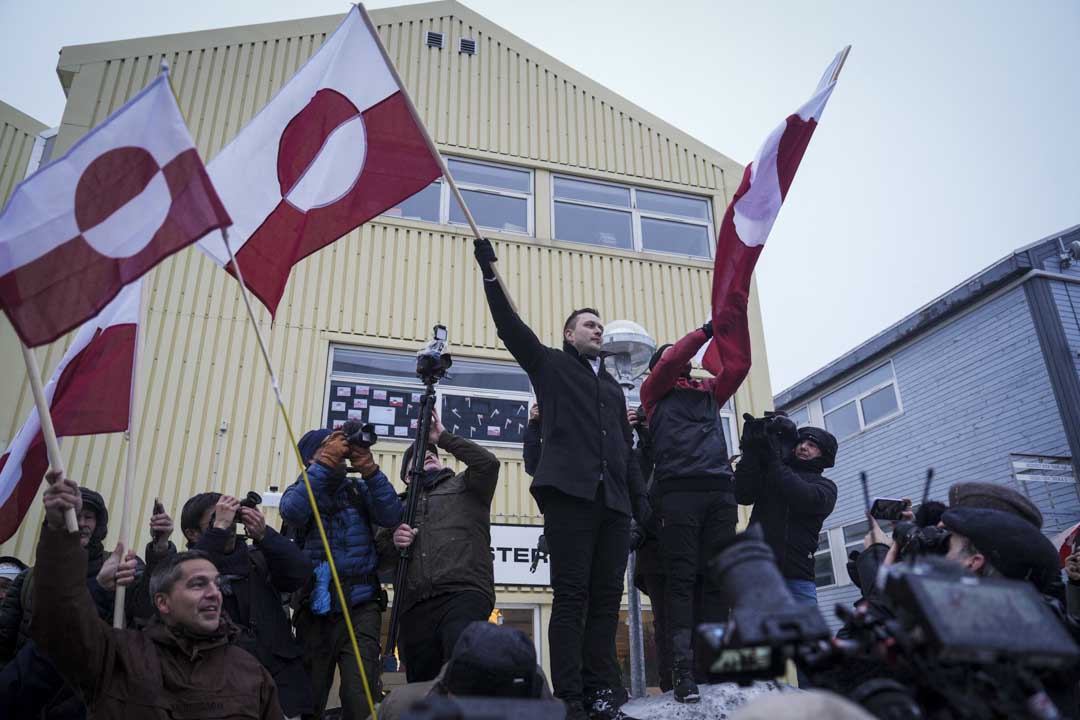
Greenland itself, which had previously sought to deepen ties with the U.S. and other North American powers, has now been pushed in the other direction. To be sure, there was never any truth to Trump’s assertions that the local population would welcome a chance to join the U.S. (his administration has also considered offering residents financial incentives). The island’s population, primarily Greenlandic Inuits, and its political leaders have long emphasised and fought for the right to self-determination, and pursued ties with other Inuit communities. They have also posited a goal of national independence. But while Greenlanders may have often been frustrated by their arrangements with Denmark, that does not mean they wanted to live under U.S. sovereignty, and Trump’s attempts at coercion have brought them closer to Copenhagen. Greenland’s prime minister, Jens-Frederik Nielsen, speaking alongside his Danish counterpart on 13 January, stated bluntly that “if we have to choose between the United States and Denmark here and now, we choose Denmark”.
How does Trump’s threatened annexation of Greenland fit in with his administration’s approach to U.S. European allies to date?
If the U.S. seizes the territory of a NATO ally, it would be an unprecedented shock to an alliance that for decades has been a cornerstone of transatlantic security and strategic planning, even if the relationship has looked increasingly shaky over the course of Trump’s second term.
As codified in the 1949 North Atlantic Treaty that established NATO, the U.S., Canada and the European members of the alliance are bound to defend one another. In practice, this pledge has meant that the U.S., with NATO’s biggest military and the world’s second-largest nuclear arsenal, has deployed huge numbers of troops and significant military equipment to Europe to help assure the security, sovereignty and territorial integrity of regional allies in the face of a variety of threats. In exchange for shouldering much of Europe’s security burden, Washington has enjoyed loyal allies and partners in its international endeavours (and wars) and had enormous sway in all alliance decisions. But defence aid has also gone both ways: to date, NATO’s Article V commitment to mutual defence has only been invoked on behalf of the U.S., which other allies acted to support after the terrorist attacks of 11 September 2001.
Washington and its allies have debated the division of labour and cost burdens inherent in this arrangement almost since its inception. There has been plenty of U.S. bellyaching about doing more than others. But others have also griped about imbalances. France, for example, has been a long-time proponent of more “strategic autonomy” for European allies. In some ways, President Trump’s complaints, such as his demands that allies spend more on defence, have echoed those of other U.S. presidents (though Trump is the only one to erroneously formulate the problem as a failure by other states to “pay their dues”, as each country pays its own way, for its own defence, rather than contributing to a common pot).
But other aspects of Trump’s rhetoric and policy seem intended to call into question the commitment of the U.S. to its allies and, indeed, appear hostile to these long-time partners. One is his repeatedly expressed doubts as to whether the U.S. would act under Article V if a NATO ally were attacked. The Trump administration has also spoken many times of drastically reducing the U.S. troop presence in Europe, even though such a drawdown would substantially shorten the U.S. military’s global reach. The Trump administration’s disdain for the continent’s elites (whom he blames for edging toward “civilisational erasure”) is paired with openly expressed support for what its 2025 National Security Strategy terms “patriotic parties”. The latter comprise those representing right-wing ideologies and aiming, among other things, to weaken the European Union, to say nothing of existing governments. This talk has alarmed many European leaders, who see in it a U.S. effort to undermine EU cohesion and, indeed, the bloc’s member states.
The Trump administration has decisively backed away from its predecessors’ support for defending Ukraine from Russia’s full-scale invasion.
Perhaps most importantly in the immediate term, the Trump administration has decisively backed away from its predecessors’ support for defending Ukraine from Russia’s full-scale invasion, begun in February 2022. While Washington continues to provide intelligence to the Ukrainian armed forces, and is selling weapons and materiel to other allies to provide to Kyiv, it is no longer authorising new military aid paid for by the U.S. The Trump administration has also positioned itself as a mediator between Moscow and Kyiv, an exercise that thus far has forced the Ukrainian government to back down from a number of stances, including reversing its prior opposition to a ceasefire and publicly speaking of de facto loss of territory. Meanwhile, Moscow has rejected all proposals negotiated by the U.S. with Kyiv and stuck to its longstanding demands, which would leave Ukraine shrunken, weakened and largely undefended. European unease has been further heightened by the Trump administration’s erratic diplomacy and pointed rhetoric, which has often seemed to reserve the harshest criticism for Ukraine and its president, Volodymyr Zelenskyy.
For Washington’s allies, this about-face on Ukraine is also a failure to support and defend them. Since Russia’s full-scale invasion, NATO and EU leaders have agreed that the war not only poses an existential threat to Ukraine, but also demonstrates that Moscow is a menace to the security of alliance members and all of Europe. As Crisis Group has written previously, they believe that Russian success in Ukraine, whether attained on the battlefield or through negotiations, would embolden the Kremlin to venture further acts of coercion, and likely aggression, elsewhere in the region. For the U.S. to end its support for Ukraine, therefore, would not just endanger the future and the sovereignty of Kyiv, but it would also undermine the security needs of NATO members across Europe.
What will Trump’s threats to Greenland mean for U.S. relations with Europe?
Trump’s actions over the first year of his second term lit a fire under efforts by European NATO members (and Canada) to reduce their reliance on Washington. But in the face of what they saw as a substantial and growing threat from Moscow, allies hoped to maintain the deterrence provided by visible alignment with Washington, the infrastructure and command backbone provided by the U.S. military, and whatever could be salvaged (or bought) of U.S. aid for Ukraine at least long enough for them to find ways to replace all three.
The result has been what some have termed “strategic acquiescence”: European states boost their own military strength and dispatch their diplomats to help Ukraine avoid capitulation, while their leaders praise Trump and the continuing relationship with the U.S. At the June 2025 NATO summit in The Hague, alliance members appropriately gave the Trump administration credit for pushing them to raise their defence and related infrastructure spending to 5 per cent of GDP. In addition, almost all European leaders avoid overt critiques of the U.S. president or his policies even when they view Washington as violating international law, as in Venezuela.
It is … hard to imagine the [NATO] alliance holding together if its most powerful member begins to prey on the others.
From the beginning, this approach had its critics, who argued that it was failing to keep the U.S. committed while squandering what leverage European allies had and undermining the international order upon which Europe relied. But the pressure that the administration is applying to Denmark and Greenland may prove too much even for the architects and defenders of strategic acquiescence. The tactic relies on convincing the U.S. to remain a reliable enough, if not fully trustworthy ally. But the Greenland crisis indicates that Washington poses its own threat to NATO members’ security and territorial integrity, with Trump’s admonitions (eg, that the U.S. will act on Greenland “like it or not”) echoing those of Russian President Vladimir Putin chastising Zelenskyy on the eve of the invasion of Ukraine. Nor is it clear, given Trump’s comments about Canada, that ceding Greenland would necessarily sate his expansionist appetite as concerns NATO allies. Danish Prime Minister Mette Frederiksen said on 5 January, a U.S. seizure of Greenland would break NATO, and it is indeed hard to imagine the alliance holding together if its most powerful member begins to prey on the others.
Nonetheless, a certain amount of strategic acquiescence was in evidence in early responses to Trump’s January Greenland comments. On 5 January, leaders of the Nordic-Baltic countries expressed support for Denmark, but without mentioning the U.S. On 6 January, France, Germany, Italy, Poland, Spain, the UK and Denmark issued a carefully worded statement underlining that Greenland belongs to its people and that Arctic security is a priority for NATO that must be achieved “by upholding the principles of the UN charter, including sovereignty, territorial integrity and the inviolability of borders”. Denmark and Greenland dispatched their foreign ministers to Washington to meet with U.S. Vice President JD Vance and Secretary of State Marco Rubio on 14 January, intending to convey their unwillingness to budge while also signalling a commitment to maintaining friendly allied relations. (The meeting resolved nothing.) A number of leaders, including Germany’s Friedrich Merz, Hungary’s Victor Orban and Italy’s Giorgia Meloni, emphasised the need to solve the issue within NATO, reflecting their desire to keep the U.S. engaged in the alliance.
But as the Trump team continued to dig in, Denmark and other NATO and EU members began to act more forcefully. A week after Trump’s initial comments, Greenland, Denmark and other European NATO allies dispatched personnel to increase the military presence in Greenland. After the failed 14 January meeting, more NATO member states committed troops. The deployments, which have reinforced about 200 Danish troops with contingents ranging in size from one to fifteen persons from, reportedly, Belgium, France, Finland, Germany, Iceland, the Netherlands, Norway, Slovenia, Sweden and the UK, are intended to contribute to an exercise series, Arctic Endurance, the timing of which was moved up. According to the Danish defence ministry, its purpose is to improve interoperability and “strengthen the alliance’s footprint in the Arctic”. Copenhagen and other participating capitals have stated consistently that the forces are, in part, a response to Washington’s claims that Greenland might not be secure enough. Still, some media have referred to them as a tripwire force and President Trump seems to have interpreted the deployments as a provocation.
Tension between Washington and its allies escalated in the days that followed. The U.S. president’s spokeswoman, Karoline Leavitt, described a working group agreed to by U.S., Danish and Greenlander officials as intended to facilitate the “acquisition” of the island, even as representatives of Denmark and Greenland stated that its goal was simply to seek ways to address U.S. security concerns. On 18 January, Trump threatened Denmark, France, the UK, Finland, Germany, the Netherlands, Norway and Sweden (the countries perhaps most widely reported to be participating in the military deployments on Greenland) with 10 per cent tariff increases, rising further to 25 per cent in June, to remain in place until the U.S. has a deal in place to take control of the island. Then, in a bizarre message to Norway’s prime minister, also provided to other European governments, the U.S. president berated his counterpart for Norway’s purported decision not to give him a Nobel Peace Prize (an honour over which Oslo has no jurisdiction), questioned Denmark’s claim to Greenland and stated “The World is not secure unless we have Complete and Total Control of Greenland”.
EU and NATO members have remained fairly united in their support of Denmark and concern about U.S. bombast.
EU and NATO members have remained fairly united in their support of Denmark and concern about U.S. bombast, but they continue to hope that the U.S. can be convinced to shift its approach, and officials surely worry whether unity will last. Italy’s Meloni reportedly telephoned Trump after the tariff threat. She indicated after the call that he had misunderstood the troop deployment, viewing it as shaking a fist at the U.S. rather than assuaging his concerns about Arctic security. She then said imposition of U.S. tariffs on “those countries that have chosen to contribute to Greenland’s security is a mistake, and I do not agree with it”. There have been discordant notes: Hungary, whose President Orban has, like Meloni, enjoyed a good relationship with the U.S. president, announced that it had blocked a proposed EU statement on the grounds that the crisis is not an EU issue. A number of European diplomats reportedly told the Financial Times that they felt the Danish deployment and exercise plans might have been an error in judgment. But if there is no unanimity on tactics, EU and European NATO members remain in agreement on the overall goals.
Despite Hungary’s position, U.S. tariffs would be an EU issue because, even if they only target some members, they would affect the trade bloc as a whole. In response to the threat, the EU parliament has decided to hold off on the trade deal the Union signed with the U.S. in July 2025, accepting previous U.S. tariffs. This step gives them the space to retaliate in kind. Brussels is also now considering, at France’s initiative, activating the EU’s anti-coercion instrument, which frees the European Commission to undertake any of a range of measures against states looking to coerce the EU, including technology taxes, investment restrictions and limits on access to public procurement. Use of this instrument, which was adopted in 2023 to sharpen the tools for countering Chinese economic coercion but as yet not used, would require majority agreement among the 27 EU member states.
None of these moves marks the definitive end of “strategic acquiescence”. To the contrary, European leaders have embarked on a substantial campaign to engage the Trump administration diplomatically to find a collaborative way forward that doesn’t deal a blow to Denmark’s sovereignty. But while Trump seems willing to talk, he has not, at the time of writing, budged from his position. If the Trump administration moves forward with its plans, allies may have to decide whether they will accept a Washington that undermines such core interests as the sovereignty and territorial integrity of one of their own or if they will push back – as Canadian Prime Minister Mark Carney encouraged in a landmark speech at Davos – and risk having to live without their ally and long-time protector. The former choice bodes ill for the region’s stability, as it risks that the U.S. will continue to strong-arm its allies while providing at best an unreliable security guarantee when it comes to Russia (and likely other threats). The latter, however, also leaves Europe facing the prospect of coercive pressure from both Russia and the U.S., and without whatever residual deterrent value even a paper alliance with Washington might have offered.
Can anyone in Washington stop Trump from breaking the alliance?
Congress has tools for preventing the president from annexing Greenland – eg, by passing legislation stating that no U.S. funding may be used for military action aimed at acquiring the island. For such a bill to pass, however, Trump’s fellow Republicans would have to join forces with Democrats in greater numbers than they have thus far on national security matters. While three Republicans recently voted to block further strikes on alleged drug smugglers at sea and additional military action in Venezuela, their numbers were insufficient to get the legislation passed, and well short of the super-majority that would be required to overcome a near-certain presidential veto. (The initial procedural vote to advance the resolution included five Republicans, but two were swayed under pressure to reverse their position. The final vote was 51-50, with Vice President Vance breaking the tie.)
To be sure, annexation of Greenland is not popular. Recent polling finds that only 17 per cent of respondents approve of Trump’s efforts to acquire the territory and only 4 per cent support the use of military force to do so. The president’s rhetoric about the territory’s import to U.S. security does not appear to have won over U.S. voters. Many people in the U.S., even outside Washington, remain attached to NATO and other U.S. alliances. Moreover, Trump’s adventurism abroad is already under scrutiny, with some Congressional Republicans (including elements of the Trump-supporting “Make America Great Again” movement that remain wary of foreign entanglements) criticising the Venezuela operation that deposed President Nicolás Maduro. Europe also has more friends in the U.S. Congress than Maduro, and it seems likely that Trump is already hearing from members who worry about the prospect of a transatlantic breach and its potential impact on their political fortunes with midterms coming up later in the year, particularly if the conflict results in further damage to the U.S. economy.
It is not at all clear that members of the president’s party will credibly threaten legislative opposition to something [Trump] deems a national security priority.
Still, it is not at all clear that members of the president’s party will credibly threaten legislative opposition to something he deems a national security priority. While some Congressional Republicans have suggested they would, the number is still limited. A bipartisan congressional delegation that included six senators, two of whom were Republicans, visited Copenhagen on 16-17 January. Among those in the delegation, Republican Senator Thom Tillis singled out the role of Congress and stated that he would remind his hosts that “I believe that there [is a] sufficient number of members … that are concerned with this”. Senate Majority Leader John Thune has also sought to calm concerns about the administration’s Greenland policy, noting that “there’s certainly not an appetite here for some of the options that have been talked about or considered”. Thune’s House counterpart, Speaker Mike Johnson, also sought to downplay the idea of military force, stating that he “doesn’t foresee military intervention in Greenland”. Some other Republicans have similarly chimed in, but many have generally avoided the topic, with even Tillis soft-pedalling what he would do if Trump actually invaded. On 19 January, a Democratic representative spoke of a bipartisan effort at legislative pushback, but thus far there is little evidence of traction.
There may also be opposition to Greenland adventures among the president’s staff and cabinet. In contrast to military intervention in Venezuela, which was championed for months by Rubio and the powerful White House deputy chief of staff, Stephen Miller, the push for acquiring Greenland is mostly a project of the president himself, although members of his administration have since echoed his position. In the past, Trump’s advisers have reportedly been able to channel his fixation on Greenland in directions less destructive than territorial conquest. Their task may be more difficult now, with the president emboldened and the guardrails against the abuse of executive power eroded. But key officials may try to identify a less confrontational approach that they can either sell to the president as a win or kick the can down the road long enough that Trump’s attention turns to something else.
For example, officials could advocate new joint arrangements among the U.S. and Greenland and Denmark to bolster the island’s defence. While these may not change force posture and arrangements, the deals would bear the imprimatur of President Trump and perhaps they could be named after him. One avenue for mapping alternative arrangements could be the Congressional Greenland Caucus, which was established in March 2025 and, according to someone involved in its activities, was intended as a forum for developing means of de-escalation. Such approaches would be in line with European efforts to find a diplomatic solution within NATO. While Trump has shown no interest in off-ramps to date, they may be useful at a later stage and should remain part of the conversation. If he perceives that the costs of continuing down the road of coercion are sufficiently high – whether because of domestic political pushback, jittery markets, or an assessment that the risks and costs of a collapse in transatlantic relations are more than he is willing to bear – his interest could yet be piqued.
If push comes to shove, what kind of leverage could Europe apply to the U.S. and what are the risks?
European NATO and EU members are fully cognisant of the enormous costs of losing the U.S., even a less reliable one, as an ally. This awareness has been the driving force behind strategic acquiescence. Now, they face the challenge of standing up for themselves while keeping off-ramps from the present confrontation front and centre in their discussions with Washington. They must perform this balancing act while avoiding Washington deciding that they are acting provocatively, and then choosing to retaliate or even act pre-emptively, at enormous cost to the alliance and to member state economies.
To encourage the Trump administration to take those off-ramps, European leaders should make clear that if Washington continues on its present path, they will at some point have no choice but to take steps that would be painful for the U.S., even if they also hurt Europeans, because the alternative of bowing to U.S. demands would be worse. But the steps they discuss, primarily military and economic in nature, must be ones they are willing to take, and thus must be agreed upon in advance, with the costs, including escalatory risks and the danger to alliance unity, carefully considered before they are added to the list. Further, the Europeans should communicate the message to Washington behind closed doors, to key members of Congress and others with influence over the president as well as directly to members of his administration.
Underlining the danger to NATO may not sway a president who embraces disruption, has shown a high threshold for risk and has openly questioned the alliance’s value.
NATO and EU members are surely already doing their best to impress upon Trump (and key members of Congress) that if the U.S attacks, or continues to try to coerce, its allies, the transatlantic relationship will change irrevocably, with repercussions that Washington surely wants neither to bear nor be responsible for. Of course, underlining the danger to NATO may not sway a president who embraces disruption, has shown a high threshold for risk and has openly questioned the alliance’s value.
But other messages that spell out in greater detail what a true rift would portend might have a better chance of breaking through. For example, senior European defence officials could whisper to friends inside the U.S. who might have influence over Trump that if the pressure on Greenland becomes serious enough, they may have no choice but to evict U.S. forces from key bases of their choosing, including those crucial to current or planned operations in the Middle East. Some experts have also suggested that European states threaten to reduce their purchases of U.S. weapons – thus dealing a blow to the U.S. arms industry – though if they take the step, they would have to be prepared to follow through and make do with fewer weapons for both Ukraine and themselves.
With respect to mobilising economic pressure, options under consideration can be powerful, especially the use of the EU’s anti-coercion instrument, but would require EU member states to muster the necessary majority to activate it. U.S. Treasury Secretary Scott Bessent spoke derisively about Europe’s ability to mount economic pressure, but investors may apply pressure of their own. The dollar and U.S. Treasury bonds, which usually rise in value during global crises, dipped at the start of the week of 19 January. European entities, most of them private, hold some $12.6 trillion in U.S. financial assets. A mass sell-off is unlikely, but at least one Danish pension fund announced on 20 January that it was divesting itself of $100 million in U.S. Treasury bonds.
That said, if muscular steps engender massive retaliation, the consequences would be grave. Washington would surely raise the stakes of the trade war that it has already started, creating an escalatory dynamic that would further batter already beleaguered European economies. On the military side, Washington might well repudiate NATO altogether, severing defence ties with NATO partners, and cutting off what is left of support, sales and deliveries to Kyiv. In the case of Ukraine, such U.S. retaliation would be, to say the least, a substantial blow. Though France says it is now providing for two thirds of Ukraine’s intelligence needs, it is likely that critical information would be missing without U.S. help. Further, the U.S. could prohibit its allies from sharing information it gives them with Ukraine – or simply stop sharing it in the first place, further limiting what Ukraine gets. It could also cut off Ukrainian access to the Starlink telecommunications network, which is crucial for the war effort, and halt support for gear already provided. Meanwhile, the end of sales of new weapons would weaken Ukraine’s air defence capabilities and exacerbate its ammunition shortages.
Ukraine would surely fight on under these circumstances, and its European backers will continue to provide information, build weapons, help Ukraine do so and seek other providers, as through the Czech initiative that has supplied Ukraine with millions of artillery shells to date, procured from around the world. But without U.S. gear and information, Ukraine’s weakened capacity to defend military installations and civilian infrastructure, including the energy sector that Russia has pounded so heavily of late, will translate into more losses of people and territory. Further, in a war in which both sides are looking to demonstrate they can outlast the other, a withdrawal of U.S. support would give Russia reason to think it is in the far better position.
As for the capacity of European states to provide for their own defence without the U.S., much depends on how they define their terms. The NATO structure that has served them over the decades is one designed around Washington – U.S. leadership, U.S. forces, U.S. equipment and the U.S. way of war. Losing the U.S. will make the existing system inoperable. The question then becomes what takes its place, how rapidly and what of the old infrastructure will be salvageable. Certainly, replacing the U.S. item for item and soldier for soldier would be extremely costly and probably impossible. But as Crisis Group interlocutors have suggested, a European approach could be very different, and rely, for example, on smaller footprints and asymmetric strategies to deter attack and defend territory.
Still, this new European way of war has yet to be developed. Finding a way to combine France’s doctrine of warfighting with those of Britain, Spain, and Hungary (to name a few) into a coherent whole would not be easy, and it is hard to imagine it happening quickly. Getting the force posture to match may be even harder. Even if their vision is not to match the Russians weapon for weapon, European nations will need to massively ramp up defence production, and however creative they get, they will have gaps to fill. European militaries will need substantial upgrades in indigenous airlift, long-range target acquisition capabilities, anti-submarine capacity and a range of other pieces of the puzzle that will be missing, or at least incomplete, without the U.S. Even planners defining how European forces might deploy to Ukraine, should that become possible after a ceasefire, have struggled to find ways to meet logistics challenges without U.S. help. Of course, the financial implications of this course would be substantial and would likely far outpace even the existing efforts to increase defence spending.
Then there is the question of nuclear deterrence. While some may be confident that the forces of France and Britain are sufficient to deter attack on themselves and allies they keep or take under their umbrella, others have doubts. But the real question is what would actually deter Russia – and that judgment will only be made in Moscow. Up to now, Russian strategic thinking has focused on the U.S., viewing the French and British nuclear arsenals as relevant mainly to arms control discussions. As that shifts, Moscow’s assessment of what damage Europeans could do it, and under what circumstances, will surely factor in both nuclear and conventional capabilities – indeed, the latter may be more important, in that they are more likely to be used.
Back-filling for the U.S. would be a tall order, but not necessarily an impossible one, if non-U.S. NATO members have the political will to work together.
In sum, back-filling for the U.S. would be a tall order, but not necessarily an impossible one, if non-U.S. NATO members have the political will to work together, including when the going gets tough, as it well might. The countries of Europe have tremendous wealth, capable military personnel and, indeed, in the cases of France and the UK, nuclear weapons. Ideally, if they do have to go forward without their longstanding partner, they can make use of at least some infrastructure provided by NATO, which offers an institutional approach to defence planning and coordination and can continue to do that, at least, even without the U.S. Moreover, while Russia is learning from its war in Ukraine, that war has also shown that it is far from unbeatable, even as Russia’s own statements indicate that it is keenly aware of its own perceived vulnerabilities.
Perhaps one model for the future can be found in the many initiatives that have developed over the last year, some entirely new and some leveraging past efforts, from various coalitions of the willing to Nordic-Baltic Eight cooperation. These formal and informal groupings are in effect collaborating to attain diplomatic goals, such as support for Ukraine in negotiations with the U.S. and, through it, Russia. They are also working toward military goals, such as more robust and adaptable defence postures in key regions. As they evolve, they may become the basis for a new European security order, one which the U.S. may once again, at some point, realise is to its benefit.
Of course, if the U.S. changes course and accepts a face-saving solution, such as joint NATO build-ups on Greenland, some allies may try to return to a version of the status quo ante. But perhaps only until the next crisis. The new threats to Greenland, after all, came on the heels of the U.S. raid on Venezuela, in which commandos seized the country’s president and his wife; against the background of escalating threats to attack other countries in Latin America and vows to bomb Iran if violence against protesters there escalated; and alongside increasing repression of protesters decrying Trump administration actions at home. All of the above furthers the impression of a president comfortable using war as an instrument of statecraft, in full violation of international law and norms, buoyed by past tactical successes and emboldened to act without restraint.
European leaders would certainly be wise to try retaining U.S. engagement for as long as it provides more value than it does harm. But that timeline may be getting shorter. Even if Europeans succeed in coaxing Trump to drop his Greenland campaign through a mix of statecraft and carefully seeded warnings about the implications of a true transatlantic breach, they will need to be prepared for that rupture to come when the next crisis arises.
