South Africa’s G20 Juggling Act
emactaggart
South Africa’s G20 Juggling Act
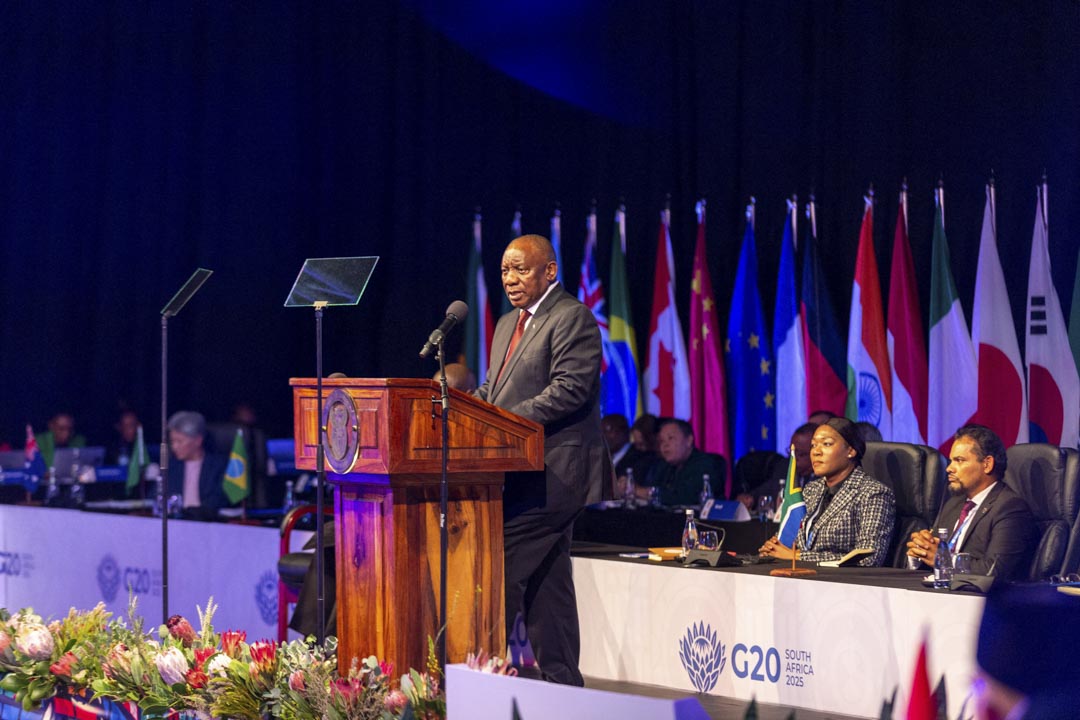
On 22 and 23 November, South Africa is hosting the Group of Twenty (G20) leaders’ summit, convening heads from the world’s most powerful economies alongside dignitaries from the European Union and the African Union (AU). It is the first time that an African country is chairing the group. From the outset, sceptics in South Africa described the G20 presidency as a poisoned chalice that threatens to put huge strain on the government at a time of rising geopolitical competition. Their foreboding has turned out to have been at least partly right. Even before the first substantive G20 meeting of the South African presidency had taken place, a newly inaugurated U.S. President Donald Trump baffled Pretoria by accusing the government in February of “fuelling disproportionate violence” against white landowners. Uncertainty as to whether the U.S. would take part in the summit then became a constant in local news coverage. Trump said in September he would not be going before declaring on 7 November that he had barred all U.S. officials from attending, branding South Africa’s hosting of the G20 a “total disgrace”. As a result, Vice President JD Vance cancelled his trip to South Africa and a subsequent scheduled visit to Kenya. This G20 leaders’ summit will thus be the first without a U.S. leader since the gatherings began in 2008.
Even so, a number of observers insist that South Africa has made the most of a difficult task. A vocal advocate of multilateralism since the abolition of white minority rule in 1994, South Africa has battled to use its G20 presidency to uphold the values of multilateral cooperation, with the bloc offering a unique platform in the build-up to the summit for economic coordination among powers with divergent views, including China, Russia and the U.S. President Cyril Ramaphosa has mended fraying relations with the EU and its member states, brought leading Global South nations together with Western powers and won support for a vision of “solidarity, equality [and] sustainability”. South Africa has also sought to involve the AU more deeply in the G20 after the organisation joined in 2023, hosting pre-summit consultations at AU headquarters in Addis Ababa and elsewhere.
The U.S. boycott [of the G20 summit] is a loss that has lowered the meeting’s profile, though representatives of many nations have sided with the hosts.
Post-apartheid South Africa is wedded to the defence of traditional multilateral cooperation. But the contrast between the vigour of South Africa’s diplomatic initiatives and the likely attendance at and outcomes of the leaders’ summit remains galling. The U.S. boycott is a loss that has lowered the meeting’s profile, though representatives of many nations have sided with the hosts, expressing irritation with the Trump administration and noting that its stance will only serve to weaken U.S. influence in the future. Another expected absence is that of Russian President Vladimir Putin, who has stopped travelling to countries that are legally bound to comply with the warrant for his arrest from the International Criminal Court. The Kremlin has promised to send a high-level official instead. China’s Xi Jinping is likely to dispatch Premier Li Qiang in his place. Javier Milei, president of Argentina, will skip the event seemingly out of sympathy with the views of his ally and financial benefactor Trump, and it remains uncertain whether a number of other leaders will show up.
Making matters more complicated is the fact that South Africa is to formally hand over the rotating G20 presidency to the U.S. at the leaders’ summit. It is unclear what the procedure will now be. Nor is it likely that the leaders’ summit will end with a joint declaration – a regrettable first for the G20. Ramaphosa nevertheless appeared unfazed when asked by reporters about the U.S. boycott. “The G20 will go on, all other heads of state will be here. In the end, we will take fundamental decisions and their absence is their loss”. On 18 November, South Africa’s foreign minister, Ronald Lamola, turned the dial up a notch by saying that the countries attending the G20 could still adopt a declaration and that the summit “should send a clear message that the world can move on with or without the U.S.”. Media reported the next day that the U.S. had formally warned South Africa that it will block any outcome framed as a consensus G20 position.
A World Divided
Recent G20 summits have displayed the extent of the discord among the world’s largest economic powers, above all in the wake of Russia’s all-out invasion of Ukraine. Preparations for the 2025 event were no exception. Divisions over the wars in Ukraine and Gaza impeded the bloc’s members from taking a common position on them, although Western officials mostly blamed the awkwardness of discussions about Ukraine on Russia’s presence. The Chair’s Summary of the first foreign ministers’ meeting – a readout of the proceedings published in lieu of a statement – mentioned “agreement” on supporting “all efforts toward a just peace in Ukraine, Palestine, Sudan, the Democratic Republic of Congo and other major conflicts around the world”. Washington was represented in this gathering by its chargé d’affaires in South Africa, who struggled to be heard during the meeting and resigned shortly afterward for family reasons.
U.S. opposition to South Africa’s G20 presidency stems from other causes, however. From the very start, and over the course of more than a hundred meetings throughout the year, including among foreign ministers, finance ministers, development finance institutions, business lobbies and think-tanks, Washington has baulked at what it sees as South Africa’s progressive agenda on issues such as inclusive global governance, debt relief for low-income countries, and funding for climate resilience and green energy transitions. President Ramaphosa has carefully navigated geopolitical divides while trying to engineer progress on policies that in his view underpin African priorities. But each of these has appeared to be anathema to the Trump administration.
The U.S. did join some working groups over the course of the year, but it mostly sent low-ranking officials who lacked the diplomatic weight to speak authoritatively or who rallied like-minded partners to advance Washington’s policy positions. South Africa’s approach was to adjust proceedings accordingly. During tough discussions of renewable energy, South Africa’s electricity minister impressed diplomats in the room by running a roll call as to who supported Pretoria’s position after the U.S. refused to back it. Only Saudi Arabia declined to say. Still, in discussions of finance, South Africa managed to find common ground by brokering a joint communiqué in July in support of the independence of central banks and reaffirming the importance of the World Trade Organization.
U.S. readiness to snub the summit is … about more than diplomacy gone sour.
U.S. readiness to snub the summit is nevertheless about more than diplomacy gone sour. Trump’s secretary of state, Marco Rubio, gave vent to the administration’s pointed dislike of Pretoria in February, dismissing the country’s supposed “anti-American” policies. The barbs have not stopped since then, and the targets of Washington’s ire have been many: labour and ownership laws that promote diversity and equity; South Africa’s genocide case against Israel at the International Court of Justice; its membership in the BRICS bloc; and its friendly relations with China and Russia.
Most conspicuously, the U.S. president has repeatedly accused Pretoria of turning a blind eye to killings of white farmers while claiming that the state is seizing their land. Both claims are demonstrably false. Although the police rarely break down crime data by race, black South Africans (including farm owners and farm workers) are much more at risk of being murdered than white South Africans. The government has not confiscated any farms; nor has it taken land from farmers because they are white. Despite Ramaphosa’s attempt to win over Trump in person during a stilted televised meeting in the Oval Office, he has been unable to sway Washington.
The animus toward South Africa has had far-reaching effects. In 2025 so far, the U.S. has scrapped crucial health programs, expelled South Africa’s ambassador, withdrawn a $1 billion commitment to a multilateral climate finance agreement and imposed 30 per cent tariffs on South African exports (while exempting a number of critical minerals and agricultural products), the highest on any country in sub-Saharan Africa. It also fast-tracked admission to the U.S. for dozens of Afrikaners who could show evidence that they had been victims of violence in South Africa. Even so, Ramaphosa and his team appear hopeful that they can eventually negotiate lower tariffs, which to some extent hinges on the appointment of a new ambassador to the U.S. whom Washington will tolerate.
Dogged Multilateralism
U.S. hostility has had the unintended effect of strengthening global support for South Africa. Relations with the EU had been uneasy after South Africa declined to condemn Russia’s full-scale invasion of Ukraine in 2022 on the grounds that it would not abandon its core principle of non-alignment. Joint naval exercises with China and Russia on the first anniversary of the invasion irked Western partners even more and cast doubt on South Africa’s commitment to neutrality. But at a G20 foreign ministers’ meeting in February, the mood had changed. European Commission High Representative for Foreign Affairs Kaja Kallas spoke warmly of “finding old friends”. Less than a month later, EU officials and South African politicians stood before the cameras in Cape Town in the first EU-South Africa summit in seven years, while the EU pledged to mobilise €4.7 billion for investment in the country. In October, the EU more than doubled its pledge to a €11.5 billion investment package, including money for processing critical minerals and green hydrogen.
In doing so, it helped preserve the flagship green energy program, which the South African government and Western donors see as vital to restoring social cohesion and ensuring long-term security in the country. The so-called Just Energy Transition Partnership aims to cut South Africa’s dependence on coal-fired power plants while keeping people employed. It could, if it succeeds, reposition the country as a green energy powerhouse. (At present, South Africa is by far the continent’s biggest emitter of greenhouse gases.) More broadly, the pledge also reflects the EU’s interest in reinvigorating ties with African partners. European diplomats in Pretoria told Crisis Group that they now stand on a far better footing with foreign ministry officials, with one person saying South African peers appear more open to engaging with European countries than in previous years. Key interlocutors, at least for now, seem to have put aside the post-colonial grudges that shaped outlooks on the world.
South Africa has … used the G20 presidency to explore alternative trade partnerships.
South Africa has also used the G20 presidency to explore alternative trade partnerships. Ramaphosa sent the deputy president for a working visit to Moscow in June; travelled with four ministers to the 9th Tokyo International Conference on African Development in August; and dispatched his trade minister to a high-level meeting in India the same month. South Africa has also signed trade agreements with China to export more agricultural products. By contrast, ties with Taiwan are increasingly strained after the foreign ministry instructed the island’s de facto embassy in Pretoria to move its offices to the commercial hub of Johannesburg. Taiwanese officials believe this downgrade to be caused by heightened pressure from China as the summit drew near.
The G20 presidency has also bolstered Ramaphosa’s reputation domestically as a consensus builder determined to pursue national stability and economic recovery, despite the headwinds. Though the arrival of Afrikaners in the U.S. as refugees was taken by the government’s critics as validation of their frustrations with corruption and sky-high crime rates, the national unity government that the president formed after closely fought elections in 2024 has survived, to the surprise of many. Recurrent internal frictions, particularly between Ramaphosa’s African National Congress (ANC) and its main coalition partner, the Democratic Alliance, have led to unprecedented budget delays and the removal of ministers but not yet tipped the government to the brink of collapse. Looking ahead, Ramaphosa’s main challenges lie in steering the ANC through local elections in 2026 and campaigning for a successor who is sufficiently untainted by scandal to restore the former liberation party’s moral authority.
Prospects for the Summit
Yet another concern is that, the U.S. has signalled that it wants to go “back to basics” and limit G20 discussions to the fundamentals of financial stability when it takes over the group’s presidency. Washington is likely to scrap the bulk of the G2o’s task forces and working groups, particularly those on topics such as climate finance, health and gender.
But Ramaphosa seems determined to protect the initiatives that he has pushed for in 2025. One of these is the Africa Expert Panel, a high-level body that is to give advice on how G20 policies can better serve Africa’s long-term development interests. The panel also advocates for reform of the global financial architecture. In parallel, Ramaphosa hopes to leave a permanent legacy through his appointment of an expert committee on inequality led by Nobel laureate Joseph Stiglitz, who recommends the establishment of an international panel on inequality in a report published for the G20 in November. The report cites evidence that deepening economic inequality is linked to the erosion of democracy and the rise of “authoritarian demagogues”, stressing the importance of bolstering the International Monetary Fund’s liquidity tool, Special Drawing Rights and international tax reforms to ensure “the fair and efficient taxation of multinational corporations and the very wealthy”. Pretoria is reportedly considering using the work on inequality to mould Ramaphosa’s policies over the remainder of his term in office, as well as persuading the UN or other international institutions to act upon it.
A disappointing outcome for the summit would not be for want of South African effort, but a reflection of the geopolitical flux that has spelled the demise of the post-World War II international order, as well as the particular contempt in which Trump holds Pretoria and all it represents. South Africa may struggle to put on a show of global solidarity, but at least it will end 2025 with its international relations on a stronger footing and its ties to the growing economic powers of the Global South on the upswing.
South Africa should continue in this spirit, engaging all G20 members constructively, including the U.S. where possible. Ramaphosa has remained steadfast in his focus on climate change measures, Africa’s debt crisis and green energy funding over the course of the year. He should continue to make the case for African priorities in global affairs and future multilateral engagements, while seeking to ensure that initiatives like the inequality initiative and the Africa Expert Panel endure beyond South Africa’s G20 presidency. Tough as it has become in a polarised world where misinformation is rife, balancing among its partners appears the best way to reinforce South Africa’s credibility, strengthen its support abroad and bolster the foreign investment it sorely needs.
