Meet three journalists from the Central Sahel who have been silenced by military authorities: “We’re in a dark hole”
Burkina Faso, Mali, and Niger, the Central Sahel countries each governed by military authorities that came to power through coups, are confronted by an armed conflict and a humanitarian crisis.
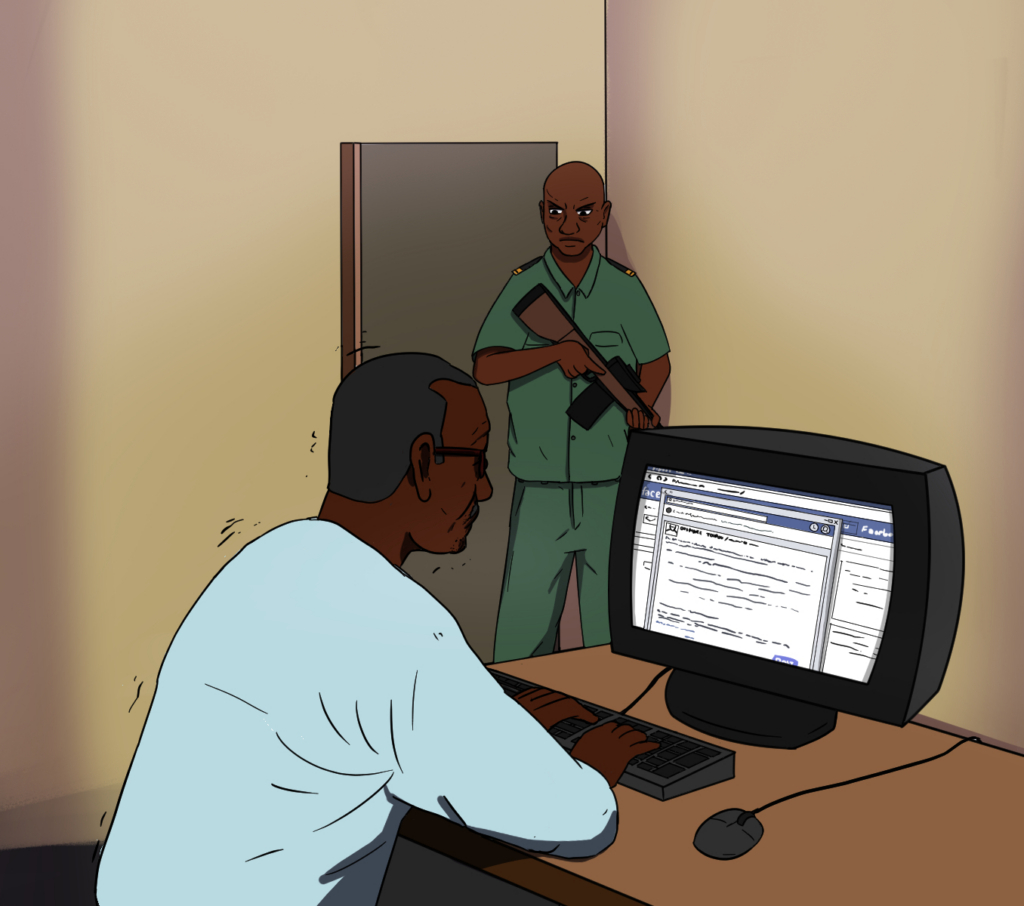
Against this backdrop, the media face unprecedented repression, with the authorities imposing an increasingly restrictive legal framework and seeking to silence criticism and suppress information on the armed conflict. Domestic and foreign media outlets have been suspended, while journalists have been prevented from doing their jobs, arrested and imprisoned. Media trade associations have been dissolved, and foreign correspondents expelled.
In Burkina Faso, four journalists and columnists were forcibly conscripted in a targeted manner into the army in 2024, and the fate of one of them remains unknown.
Amnesty International spoke to three journalists from the Central Sahel who described what journalism has become since the military took power in their countries. Their names have been changed and their nationalities withheld to protect their identities.
When silence becomes a crime: Ousmane B.*
Journalist Ousmane B.* has been living in exile for several months. He decided to leave after trying his best to do his job as a journalist. Currently in a precarious situation, he lives in hope of one day returning to his country and practicing his profession freely.
“More than a dozen journalists I know have been harassed and threatened, even to the point of being abducted or arrested. Every time I’ve spoken out in support of a colleague who was abducted, I’ve been told, ‘You’ll be next’. I’ve received threats of physical assault, arrest, and abduction… I’ve been called ‘unpatriotic’. Even now, I still receive hostile messages from time to time. I don’t feel completely safe, even outside my country.
In newsrooms, we’ve known which topics we can’t cover – like an armed attack that’s happened somewhere. There’s no need to discuss such topics in editorial meetings because we won’t do anything about them. It’s also difficult and risky to cover the humanitarian crisis. The words you use or the angle you choose can put you in danger.
Nowadays, those who hold the power are the only ones to be ‘right’.
Ousmane B.*
For private media outlets, there is an unspoken obligation to report news in a way that glorifies the authorities and the military. Often, they relay information that comes from influencers who support the government or from the state news agency. We are supposed to verify and cross-check this information with other sources, but unfortunately, we no longer do so.
Nowadays, those who hold the power are the only ones to be ‘right’. They expect journalists to show that the country is doing well, that the security situation is improving and that the government is made up of competent people doing a tremendous job – even when that is not the case.
I know a journalist who was harassed, threatened with death, followed, and interrogated by intelligence services… Today, he works for a media outlet that supports the authorities. I’m not capable of that, but I don’t judge him. One has to make a living, feed their family, exist… The threats must have scared him. On social media, people are demanding journalists show their support for the authorities and their patriotism. In our situation, even silence is a crime.
I don’t think such restrictions on our work are necessary. In recent years, we have worked in a professional and responsible manner. Our sector was thriving. We never intended to harm our country. We simply wanted to inform the public and share our story with the world. It pains me deeply to see so many excellent journalists prevented from doing their jobs. Our media has now been silenced.”
Media forced to adhere to the national narrative: Abdoulaye O.*
Journalist Abdoulaye O.* says he left his country of his own free will because he valued his independence of thought.
“Even back when our country was supposedly democratic, journalists were already being targeted and attacked by the government or its supporters. With the rise of terrorism, laws governing citizens’ expression on social media and the coverage of such acts have become stricter… There was already a climate hostile to press freedom and freedom of expression.
With the military in power, the situation has become even more severe. Some media organizations tried from the beginning to engage in dialogue with the authorities, but the course of action had already been set, and these organizations faced reprisals. For the first time, disinformation campaigns targeted journalists, who were subjected to public condemnation. Yet journalists have never been enemies of their countries.
Those who valued their independence of mind had to leave.
Abdoulaye O.*
Diverse and critical journalism no longer exists, as it was anchored in democracy and its principles. Now, the media are reduced to glorifying the nation and its achievements, even the most insignificant ones. What is now expected of the media is adherence to the national narrative produced and disseminated by political and military authorities.
Some journalists try to adapt in order to keep their jobs and their paychecks. There is a climate of mistrust and paranoia. No one trusts anyone else anymore. But the arrests and abductions aren’t just targeting journalists. They’re targeting anyone who thinks critically and expresses their thoughts. Journalists have left the country. I don’t know how many… Those who valued their independence of mind had to leave.
Many of the questions raised by Sahelian leaders and the local population are legitimate. These people have the right to happiness and to shape their own destiny, and with free, high-quality information, we would make faster progress toward achieving these goals. I cannot say whether the future is bleak or promising. Will pluralistic, liberal, and critical journalism be able to survive? I don’t know.”
Niger: “Threatened and brought to heel”: Human rights and civic space under pressure since the 26 July 2023 coup
This report documents the deterioration of civic space and civil and political rights violations in Niger since the military coup and makes recommendations to the authorities for the protection of rights guaranteed by international human rights law and standards, as well as national law in Niger.
Hoping for change: Mohamed C.*
Mohamed C.*, a journalist and correspondent, has stayed in his country and continues to work while taking precautions to avoid repression.
“We’re in a dark hole. We can no longer do our work. Today, journalists must choose between singing the praises of this junta that claims to be sovereign, remaining silent, speaking out and ending up behind bars, or going into exile. There is no longer an independent press.
Personally, I’ve taken precautions. I try to do my work anonymously, and I collaborate with other people. Since the coup, I’ve signed one or two articles as a correspondent, but now I’m asking that my name no longer be mentioned. I haven’t been directly threatened because I haven’t spoken out publicly. I know I’m being watched. I’m careful about who I talk to and how I move around. There are a few people with whom I share values, and I work with them. We continue to stand in solidarity with one another.
Today, we no longer seek out information. Even sharing information is a crime. At least a dozen journalists have been jailed since the coup. Some are in prison for sharing an invitation to cover an event. Others have been prosecuted for sharing a news article. Before the military juntas took power, at least you could go to court to defend yourself with the evidence you gathered, but today, even if you prove that you’re saying the truth, you can be prosecuted, imprisoned, or accused of being a mouthpiece for the western countries.
Quality media outlets, with history and tradition, are at risk of disappearing.
Mohamed C.*
With state-run media, we’re dealing with propaganda. Some good journalists who worked in the private press were recruited by public media because the pay is better. They’ve become propagandists. It’s sad.
I think the crackdown is most severe in Burkina Faso, but in all three countries, there’s been a major setback. Quality media outlets, with history and tradition, are at risk of disappearing. They’re holding on, paying their staff, rent, and expenses, trying to survive… But the more time passes, the more likely we are to see them disappear. Rebuilding this core group of experienced people who can pass the torch to younger generations will take years. The international community must not turn its back on these media outlets. A mechanism to support them must be found.
I hope these military regimes will not last forever. But if tomorrow the light breaks through and finds a field devoid of journalists, the people will have no one to guide them.”
Amnesty International documented the crackdown on the media in Niger in a report released in March 2025 and launched a campaign in October 2025 to raise awareness about the situation of activists and journalists in Burkina Faso, Mali, and Niger.
*Names have been changed to protect identities.
Add your voice now
Stand with the activists and journalists persecuted in the Central Sahel
The post Meet three journalists from the Central Sahel who have been silenced by military authorities: “We’re in a dark hole” appeared first on Amnesty International.
