
The Double Dividend: Eight Reasons Why the World Cannot Afford to Keep Choosing Bombs Over a Liveable Planet

Celebrating Feminists’ Voices, Inspiring Global Peace
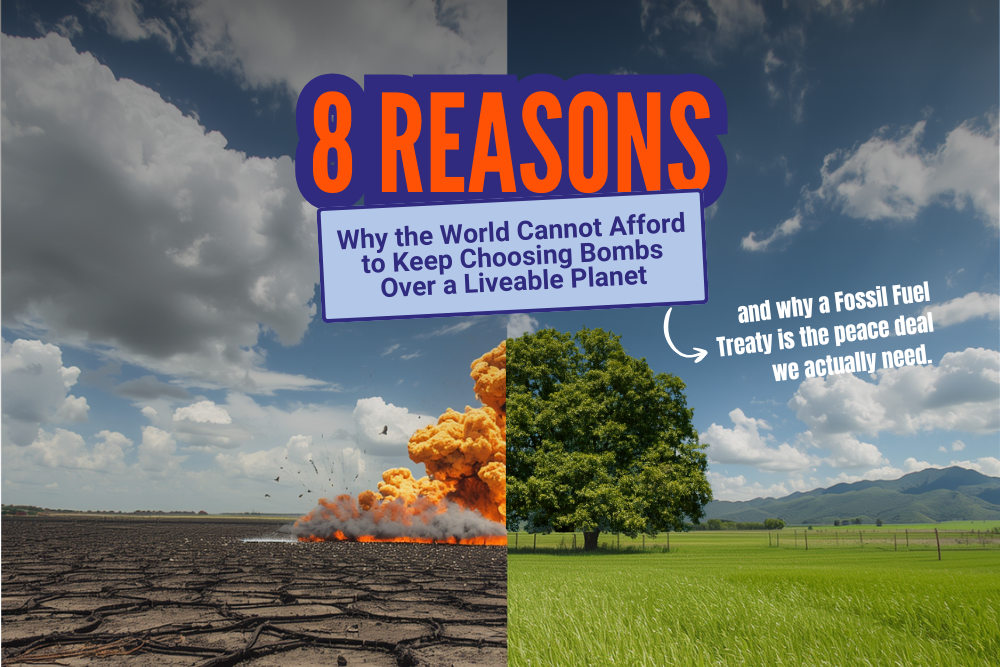
The Double Dividend: Eight Reasons Why the World Cannot Afford to Keep Choosing Bombs Over a Liveable Planet

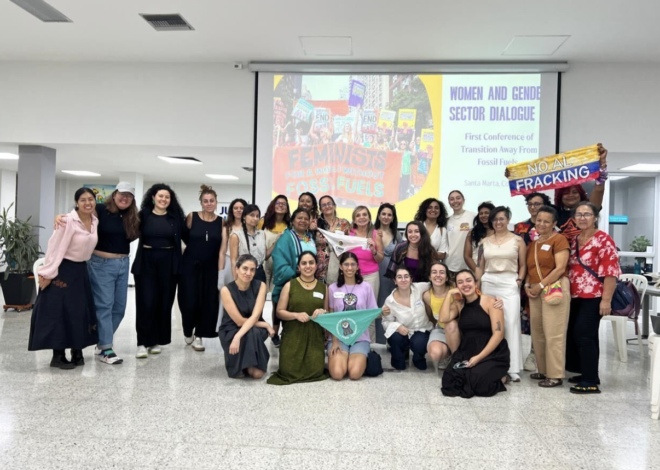
As the First Conference on Transitioning Away from Fossil Fuels is underway in Santa Marta, Colombia, calls for climate action have never been more urgent. Yet governments continue to increase military spending – reaching a record US$2.88 trillion in 2025 – while claiming there is no money for a just transition away from fossil fuels – the root cause of the climate crisis. We are facing a crisis of priorities. In this article, we set out eight reasons why the world cannot afford to keep choosing bombs over a liveable planet – alongside the launch of our new paper, “The Double Dividend: How Reducing Military Spending Can Finance a Just Transition The Fossil Fuel Treaty as a Tool for Justice and Peace“. Published on the margins of this landmark conference and in support of the Global Days of Action Against Military Spending, this blog is a part of a growing call to “Demilitarise for climate justice.”
-
12 min
Two perspectives that reflect the same global reality
Together with the Fossil Fuel Treaty Initiative, the Women’s International League for Peace and Freedom (WILPF) has spent the past months researching what should be an obvious question:
Why is no one seriously asking whether the world’s military budgets – which are growing at a pace that the UN Secretary-General himself has called alarming – could instead be financing the global just transition away from fossil fuels that the climate crisis demands so urgently?
WILPF’s new paper, The Double Dividend: How Reducing Military Spending Can Finance a Just Transition, makes the case that it can and it must. Published during the Global Days of Action Against Military Spending and during the First International Conference for a Transition Away from Fossil Fuels in Santa Marta, Colombia, this moment demands a shift in priorities.
Here are 8 reasons why:
1. We are living through a crisis of priorities, not a crisis of resources
The financing gap for a global just transition stands at trillions of dollars. Climate pledges to the most vulnerable nations remain chronically unmet. Nearly one-fifth of the Sustainable Development Goals have regressed below their 2015 baseline.
And yet, governments collectively spent US$2.7 trillion on military expenditure in 2024 for the tenth consecutive year of increase.
The richest countries are spending 30 times as much on their armed forces as they are on climate finance for vulnerable nations. The money exists. This is a crisis of priorities and political will.
2. Military spending is one of the biggest – and most overlooked – drivers of the climate crisis

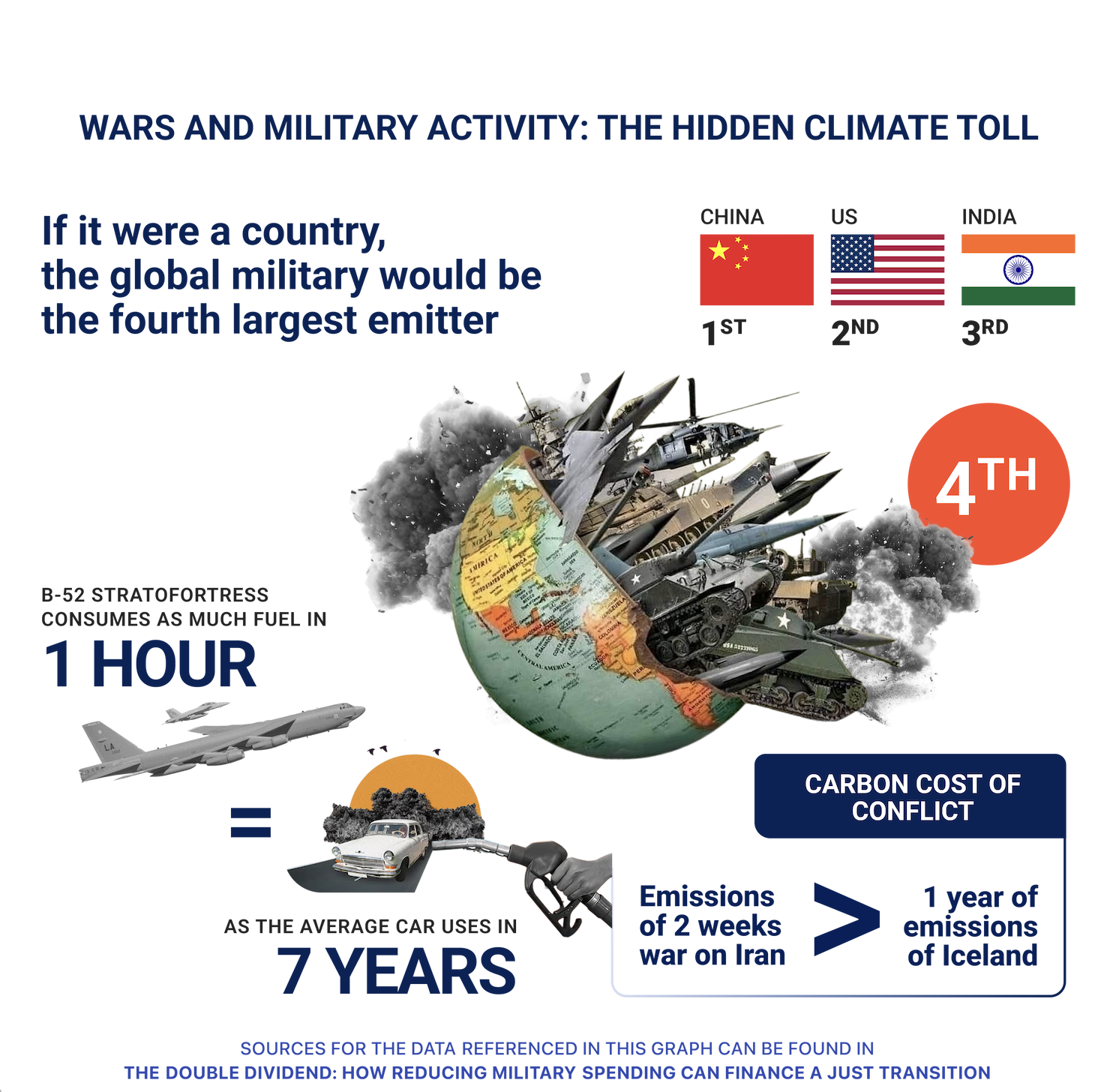
Fossil fuels are the lifeblood of modern militaries. If the world’s armed forces were ranked as a single country, they would be the fourth largest emitter on Earth – after China, the United States, and India. The top 20 military spenders are responsible for at least 10 billion metric tonnes of CO₂ equivalent of military-related emissions in the first quarter of this century alone. This is equivalent to the annual emissions of about 2 to 2.5 billion cars. That’s more cars than currently exist on Earth.
This data is almost certainly an undercount. States are not required to report their military emissions to the UN climate body, so most do not. The true figure, including military supply chains and arms manufacturing, could be three times higher.
You cannot solve a climate crisis while systematically ignoring one of its biggest contributors.
3. Wars are climate catastrophes
Military emissions in “peacetime” are only part of the picture. Active conflict releases enormous and largely uncounted quantities of carbon, while destroying forests, contaminating soil and water and obliterating the infrastructure of communities already on the frontlines of climate breakdown.
The first two weeks of the recent US war on Iran released more carbon pollution than Iceland produces in an entire year. Four years of Russia’s war in Ukraine have generated an estimated 311 million tonnes of additional CO₂ – comparable to France’s annual emissions. The first 15 months of Israel’s assault on Gaza have produced a carbon footprint greater than the annual emissions of 36 individual countries.
4. Military spending is actively sabotaging the just transition
The impacts of militarisation on the just transition extend far beyond the competition for financial resources, though that competition is stark and consequential. Military priorities are now shaping the global critical minerals agenda, with NATO and several major governments designating minerals for military use as more “critical” than those needed for renewable energy infrastructure.
Military budgets are crowding out social spending including the care economy, healthcare and education. This disproportionately impacts women and marginalised communities, the very people most affected by the climate crisis and least responsible for it.
And the current procurement surge of fossil-fuel-dependent weapons systems – fighter jets that will still be operational in 2050, warships that run on bunker fuel – are locking in carbon emissions for decades to come. There is no credible pathway to “greening” militaries operating at current scale.
5. False climate solutions are receiving the funding that real ones need
Rather than redirecting military and public spending toward a genuine just transition, governments and the military-industrial complex are funding expensive, speculative and dangerous technologies. This includes carbon capture or geoengineering that entrench fossil fuel dependence and carry significant risks of human rights violations.
Solar geoengineering start-ups are raising venture capital backed by military intelligence firms. Carbon capture infrastructure is receiving billions in public subsidies while just transition finance for the Global South receives a fraction of one percent of available climate funds. These patterns are a continuation of the same extractive logic in a different uniform.
6. Reducing military spending is not a radical idea: it is a foundational UN pillar
For Mitzi, this is intensely personal. “We are not asking for charity. We are asking for the world to apply the principles it agreed to when it founded the United Nations.”
Article 26 of the UN Charter tasks the Security Council with planning for the regulation of armaments, “with the least diversion for armaments of the world’s human and economic resources.” Since the 1960s, the General Assembly has repeatedly called for military spending reductions and the reallocation of savings to development. The current UN Secretary-General has named military expenditure reallocation as necessary for financing climate action. Article 2.1(c) of the Paris Agreement demands that military spending should be progressively reduced.
Strong political will has long existed among the vast majority of UN member states, who – despite holding the majority vote – have been constrained by the refusal of a small minority of heavily militarised states to participate.
7. A growing and increasingly powerful coalition is demanding change
What gives us genuine hope is the movement that is building. Climate Action Network, representing over 1,900 civil society organisations, has made the disruption of militarism one of its strategic goals. The Women and Gender Constituency of the UNFCCC – representing hundreds of feminist organisations globally – has called for military expenditure to be redirected to climate finance. At COP30, Brazil’s President Lula declared that spending twice as much on weapons as on climate action is “paving the way for climate apocalypse.” Panama asked: if US$2.5 trillion to arm ourselves is not too much, why is US$1 trillion to save lives unreasonable?
For Katrin, working in international advocacy, this convergence represents something new: “I have spent years watching peace movements and climate movements talk past each other. What I am seeing now, at COPs, in civil society, in the news, in academic research, is a recognition that these are not separate crises. They are a result of the same system. The climate crisis and militarism are escalating because of a small group of hypercapitalist and heavily militarised countries.”
8. The Fossil Fuel Treaty offers a concrete mechanism to make peace and climate justice happen
All of this analysis points toward a concrete proposal. The Fossil Fuel Treaty Initiative, now supported by 18 nations, thousands of health professionals, youth and climate activists, Indigenous leaders, and over a million individuals worldwide, is advocating for the negotiation of an international agreement to fairly manage the global phase-out of fossil fuels.
The proposed treaty’s just transition pillar includes a proposal for a Global Just Transition Fund. WILPF proposes that this Fund be financed in part by a reduction and reallocation of a percentage of member states’ annual military expenditure. It is a proposal that cannot be obstructed by a small number of heavily militarised states, but instead harnesses the political will of those countries that are serious about addressing the climate crisis and building a peaceful world for all.
If we, as the global majority who want peace and climate justice, continue to hold the line, we can achieve the world we envision. The Fossil Fuel Treaty – built on a UN mandate, a global civil society movement and a growing coalition of serious countries – offers a path forward.
In our struggle ahead, I, Katrin, will hold dearly the words of my colleagues and feminist peace activists Ray Acheson and Madeleine Rees of WILPF: “The leadership for an alternative future will not come from [the governments who produce and sell weapons]…They will have no alternative than to change when it becomes clear that the status quo is no longer tenable, when the tides have turned against their weapons and warfare, when other Governments have forged ahead with new plans, and when their own citizens demand redistribution of resources away from weaponised security to security based on human rights, justice and environmental sustainability.”
A critical moment for action
The First International Conference for a Transition Away from Fossil Fuels is currently underway in Santa Marta, Colombia. It is the most significant opening in the global climate justice movement in a generation. We are calling on civil society everywhere to amplify our demands and for governments attending to table, seriously and specifically, the question of military expenditure reallocation as a financing mechanism for the just transition.
Conclusion
To explore the full analysis and recommendations, read “The Double Dividend: How Reducing Military Spending Can Finance a Just Transition” — available at wilpf.org and fossilfueltreaty.org
If you would like to support this work, please consider making a donation to WILPF. Your support helps sustain feminist organising for peace and climate justice – work that is urgently needed now more than ever.
Mitzi Jonelle Tan is a climate justice activist and organizer from the Philippines. She is a youth organizer with the Fossil Fuel Treaty and a member of Gabriela Germany — an international chapter of Gabriela Philippines, an anti-imperialist Filipino women’s organization.
Katrin Geyer is the Ecological Justice Programme Manager at the Women’s International League for Peace and Freedom (WILPF) and co-author of The Double Dividend.
The post The Double Dividend: Eight Reasons Why the World Cannot Afford to Keep Choosing Bombs Over a Liveable Planet appeared first on WILPF.