Santa Marta: Ministers grapple with practicalities of fossil fuel phase-out
Government ministers and officials from close to 60 countries are on the ground in the Colombian coal-port city of Santa Marta for high-level discussions at the First Conference on Transitioning Away from Fossil Fuels.
Speaking at the opening plenary, Selwin Hart, special adviser to the UN Secretary-General on climate action and just transition, said that three out of every four people on the planet live in countries that are net importers of fossil fuels, exposing them to “shocks they did not create and cannot control”.
Against the backdrop of the Iran war, which has caused oil prices to spike, he said the urgency of transitioning away from fossil fuels “is no longer only a climate or environmental imperative. It is a security imperative, an economic imperative and a development imperative.”
Delaying the transition will only make it “more disorderly, disruptive and costly, Hart warned, adding that so far the shift to renewables has been highly concentrated in rich economies and China – “leaving most of the developing world behind”.
Comment: Santa Marta marks a new chapter in climate diplomacy
Meanwhile, a group of 18 nations – mostly made up of small island states and the host country Colombia – called on the Santa Marta summit to recognise the “urgent need to negotiate a new international instrument” for leaving coal, oil and gas beneath the ground.
They are pushing for the conference to back a formal negotiation process for a binding “Fossil Fuel Treaty” and make progress on new mechanisms for international cooperation and finance including an importers-exporters club, a global just transition fund and a debt resolution facility.
Teresa Anderson, global lead on climate justice for ActionAid International, said UN climate talks remain essential to ensure all countries act together to tackle global warming. But, she added, “a new Treaty can act as a parallel and complementary space for those that want to move faster in key areas such as phasing out fossil fuels, just transitions and debt justice, without first having to get sign-off from all nations”.
Partner content: To phase out fossil fuels, developing countries need exit route from “debt trap”
Aside from a summary report and a statement from the co-chairs, the expected outcomes from Santa Marta’s high-level debates remain unclear. While this is a source of anxiety for some delegates, others say it’s a breath of fresh air compared with the rigid format of COPs.
Climate Home News is reporting on the high-level segment of the conference on April 28 and 29. Please check back for updates throughout the day.
Host nations seek to revive flagging multilateralism
As right-wing demonstrators outside the conference venue chanted in Spanish that “fossil fuels are a god-given resource”, hosts Colombia and the Netherlands kicked off the first international dialogue of countries on reducing their dependence on coal, oil and gas.
Both countries reiterated that the conference is meant to drive forward discussions where UN talks like COPs have fallen short.
Delegates had to endure long queues under the sun to enter the five-star resort hosting the high-level segment, as security was tightened in preparation for Colombian President Gustavo Petro this afternoon.
The country’s environment minister Irene Vélez Torres opened the talks in a packed room, expressing her frustration with “fossil colonialism” and the failure of the last few COPs to debate pathways away from fossil fuels.
“Beyond frustrations, we’re summoned today to overcome the crisis of multilateralism,” she said, adding that Santa Marta seeks to become a “deeper, more democratic and more effective” alternative. “We need a multilateralism without de facto vetoes.”
At last year’s COP30 in Belém, a group of 80 countries called for the design of a global roadmap to phase out coal, oil and gas, but it was blocked by large oil producers and consumers like Saudi Arabia, Russia, India and China.
Dutch climate minister Stientje van Veldhoven noted that the energy transition will not be easy, as fossil fuel systems are “hard to disentangle” from economies. She urged countries to have an “open dialogue” and said the conference is about “strengthening multilateralism”.
Some governments also expressed the need to reinforce the UN climate negotiations, with EU climate chief Wopke Hoekstra saying “the COP process is unfortunately not always delivering what it should”, as he urged countries to “make the most” of Santa Marta. Vanuatu’s climate minister Ralph Regenvanu said commitments made here must bolster talks at COP.
Fossil fuel producers want flexibility, Indigenous peoples reject business as usual
The plenary in Santa Marta adopted a different style for its high-level dialogue compared to the UN process, as government interventions were interspersed with speakers representing social groups, from women to the private sector, who had prepared their contributions at meetings over the past three days.
The result was a mix of views, with some large oil and gas-producing nations urging caution over how ditching fossil fuels could affect their economic development, while civil society groups piled on the pressure to decarbonise fast.
Türkiye – a large coal producer and consumer that will host COP31- said progress on a just transition “will benefit from an approach that takes into account different national circumstances, capacities and development priorities”, hinting at the need for flexibility for emerging economies.
While this year’s COP president, Murat Kurum, has said that relying on fossil fuels could lead to energy insecurity and “climate collapse”, his country drew criticism for publishing an action agenda for COP31 that does not mention fossil fuels.
Türkiye sets COP31 dates and appoints Australian cattle farmer as youth champion
Oil-rich Nigeria went even further, with the country’s regional development minister, Momoh Abubakar, emphasising he would host an event on a “phase down” of fossil fuels in Santa Marta. “It is ‘phase down’, not ‘phase out’ that is giving room for transition and diversification to drive sustainable development,” he said.
Norway – which supplies Europe with much of its oil and gas – said the country is “strongly committed” to the “era of renewables”. “This needs to be happening in close coordination between all producers and consumers,” said the country’s climate minister Astrid Hoem, as global energy markets are highly interconnected.
Meanwhile, Indigenous peoples and other groups called out what they judge to be a government-led process, winning loud applause for their interventions. The Indigenous delegate said they don’t want to see “another form of colonialism cloaked as a just transition”.
“We will not stand by as our kin, our lands, our waters and our non-human relatives suffer to maintain the status quo,” she said. “This structure will not be where we found our salvation and liberation.”
Some social groups called for specific measures to be included in the conference’s main output, which Colombia has said will be a summary report. Academics called for action on methane while the private sector recommended the removal of fossil fuel subsidies that keep oil and gas prices “artificially low”. NGOs said they want Santa Marta to recognise the need for a “Fossil Fuel Treaty” to ban new extraction.

France delivers first fossil fuel transition roadmap
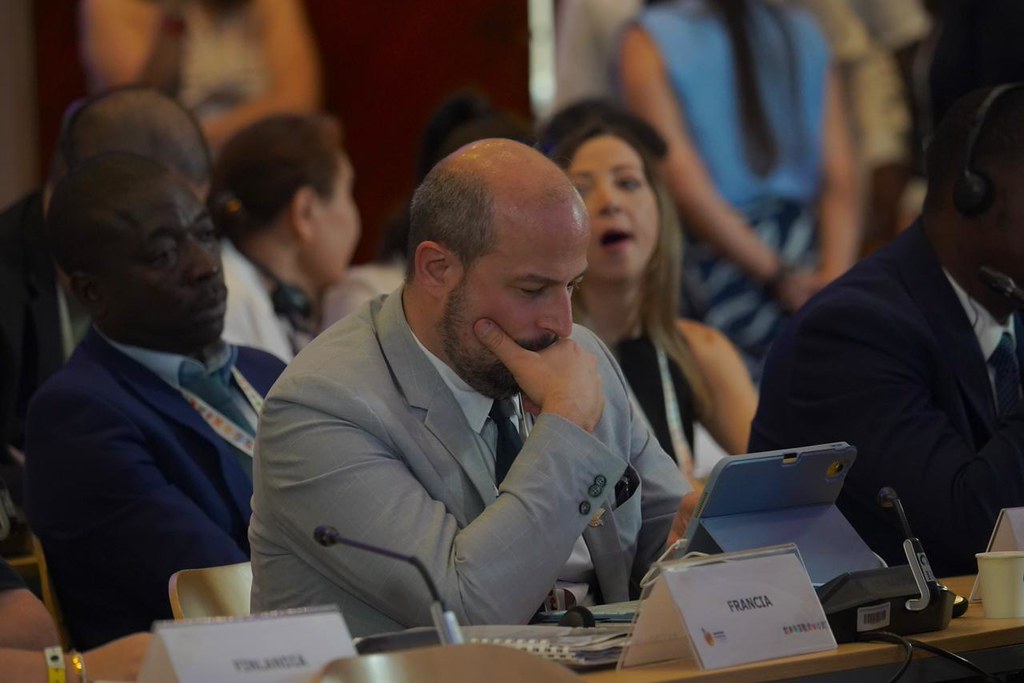
France came to Santa Marta bearing a gift that was delivered to the podium: its new national roadmap for transitioning away from fossil fuels.
Benoît Faraco, the country’s climate envoy, said France was “very proud” to be one of the first countries to publish a domestic roadmap, and encouraged others to follow suit. Both Colombia and Brazil are working on draft roadmaps but have yet to finalise them.
Cat Abreu, director of the International Climate Politics Hub said it was “a big moment to have the world’s first national roadmap to transition away from fossil fuels”. She added that the plan “rationalises France’s existing energy policies and targets into a clear direction of travel to phase out fossil fuels and it sends a strong signal to other countries that they can do the same”.
The document, which amalgamates different energy and decarbonisation plans, confirms targets France had previously set for ending the consumption of each fossil fuel: coal by 2030, oil by 2045 and fossil gas by 2050.
To get there, France aims to close its last two coal-fired power plants by 2027, carry out large-scale electrification of transport, develop alternative heating methods such as heat pumps and improve energy efficiency through building renovation, the roadmap says. France already decided a decade ago to end fossil fuel exploration and exploitation on its territory by 2040.
Faraco said France is focused on electrification and clean electricity because they provide value to local communities, will shape the future of industry, and “bring solutions when fossil fuel brings problems”.
France’s electricity mix is already 90% low carbon, he said, thanks to nuclear and renewables, and it generates revenues for the national budget by exporting green power.
France, he added, will help African nations to unleash wind power, and provide support to other countries on the frontline of the current energy crisis.

Colombian president questions whether capitalism can really go green
Preceded by an Indigenous ceremony, Colombia’s leftist president, Gustavo Petro, stopped by the conference plenary on Tuesday afternoon to warn about the consequences of continuing with the expansion of fossil fuels.
“One question that needs to be asked is whether capitalism can truly adapt to a non-fossil fuel energy system?” he said. “Today I’m sceptical.”
Petro also criticised last year’s COP30 for failing to formally adopt a process for a global roadmap away from fossil fuels, despite scientific warnings of the need to halt all new coal, oil and gas. Colombia was one of the strongest backers of the initiative.
The country is heading into an election in late May, where Petro’s designated successor Iván Cepeda is leading in the polls against far-right candidate Abelardo de la Espriella.
After a relatively brief speech that secured a standing ovation from the audience, the Colombian president quickly exited, escorted by his security team.
The post Santa Marta: Ministers grapple with practicalities of fossil fuel phase-out appeared first on Climate Home News.