

U.S. Snaps up Venezuela’s Oil and Rare Minerals in Race for Supplies
pfranz
U.S. Snaps up Venezuela’s Oil and Rare Minerals in Race for Supplies
What is happening?
As war and geopolitical competition spur the U.S. search for a guaranteed supply of natural resources, the opportunities opening in Venezuela appear to have caught Washington’s eye. Since U.S. special forces captured Venezuelan President Nicolás Maduro and his wife Cilia Flores on 3 January, the Trump administration has taken control of the country’s oil sales and exercised authority over how the proceeds can be spent. High-level administration officials have also trekked to Caracas to explore both boosting oil production and exploiting the country’s other natural assets. On 4 March, as oil prices surged in the aftermath of the U.S.-Israeli attack on Iran, Interior Secretary Doug Burgum arrived in the country, just weeks after Energy Secretary Chris Wright visited. Besides oil, the country’s ample mineral wealth also sits at the heart of the Trump administration’s interests. According to news reports, Burgum signed an agreement with Venezuela’s mining company to buy up to a thousand kilograms of gold. Washington also covets rare earth minerals that are vital for industries ranging from defence to aerospace and artificial intelligence, including building precision-guided missiles, radars, sensors and satellite systems.
The U.S. pursuit of Venezuela’s natural resources echoes what has become known as the “Donroe Doctrine”, a credo laid down by the White House in late 2025 that seeks to reassert U.S. supremacy in the Western Hemisphere. Washington has used control of Venezuela’s oil – these reserves are purported to be the largest in the world – as a justification of the mission to seize Maduro. It has made clear that interim President Delcy Rodríguez, who succeeded Maduro, will retain the top office only if she gives the U.S. access to the oil and complies with other instructions, leaving Caracas with limited room for action. Secretary of State Marco Rubio stated to Congress in late January that the U.S. will be micromanaging how revenues are spent, with Rodríguez expected to submit a monthly budget for approval before funds are released.
Venezuela’s critical minerals, meanwhile, are in the Trump administration’s sights not just because of their use in certain strategic industries, but because control of such assets located in the hemisphere is deemed vital to U.S. interests. The 2025 National Security Strategy affirms that to avoid dependence on “any outside power … [w]e must re-secure our own independent and reliable access to the goods we need to defend ourselves and preserve our way of life. This will require expanding American access to critical minerals and materials while countering predatory economic practices”.
In the coercive grip of the U.S., and eager to replenish depleted state coffers, Venezuela’s interim authorities have so far proven largely cooperative. On 5 March, Rodríguez said a reform of mining laws is in the works, and the government has carried out a sweeping reform of the rules governing the oil industry, reversing policies favouring national state control that date back two decades. The hydrocarbons law passed by the National Assembly in late January reflects the preferences of oil corporations. It eliminates a mandate imposed by the late President Hugo Chávez – who served from 1999-2013 – requiring the state oil company Petróleos de Venezuela (PDVSA) to serve as the principal stakeholder in all exploration and production projects. The new law also permits companies to negotiate lower royalty payments to the Venezuelan government, reduces tax rates and allows foreign energy firms to resolve disputes in arbitration venues abroad rather than in Venezuelan courts. Trump has called on U.S. private companies to invest $100 billion in reviving the sector. To that end, his administration has issued licences to allow U.S. and other Western companies to operate in Venezuela. That said, reviving the moribund oil industry will require hefty investment, and it may take longer than the White House expects.
Access to Venezuela’s minerals has been less heralded than its oil, but their potential has not gone unnoticed in U.S. government circles.
Access to Venezuela’s minerals has been less heralded than its oil, but their potential has not gone unnoticed in U.S. government circles. The U.S. covets so-called rare earth elements, a group of seventeen metallic elements that are essential for high-tech and green energy. Despite the name, rare earth elements are abundant. They are, however, seldom found in quantities that make them economically viable to extract. China is the undisputed leader in this industry, controlling approximately two thirds of global mineral extraction and over 90 per cent of processing capacities used to separate rare earths from mineral ore.
The ample deposits of these elements in Venezuela’s south, a region that includes swathes of the Amazon rainforest and savannahs bordering Brazil and Colombia, are all the more enticing given perceptions in the White House and Pentagon that Beijing’s dominance of the sector has become a strategic vulnerability for the U.S. This concern intensified after Beijing imposed export restrictions on seven rare earth elements on 4 April 2025, in retaliation for Trump’s tariff hikes on Chinese goods. These restrictions disrupted global supply chains and intensified competition for alternative sources of these minerals. Chinese President Xi Jinping eventually agreed to suspend the restrictions on supply for a year, in exchange for Trump reducing tariffs on Chinese goods.
Can the U.S. revive and profit from Venezuela’s moribund oil industry?
Venezuela’s oil production today hovers between 800,000 and 900,000 barrels a day (b/d), a steep fall from two decades ago, when the country produced more than three million b/d. The decline began after President Chávez sacked over 18,000 PDVSA employees – including much of the company’s management – following a politically motivated oil strike that sought to bring down his government in 2002-2003. Appointments were thereafter made on the basis of political loyalty rather than expertise, while revenues were siphoned off to pay for spiralling public spending, including on ambitious social welfare programs. Corruption and mismanagement proliferated, investment slumped and infrastructure was left to rust. The imposition of U.S. sanctions in 2019 hit an industry that was already on its knees. Boosting Venezuela’s production to the level of the late 1990s will now require enormous investment. A number of quick wins are feasible, however: rehabilitating existing oil fields and infrastructure could increase Venezuelan output to roughly 1.5 million b/d within two years, at a cost that economists estimate could surpass $10 billion.
Despite Trump’s enthusiastic encouragement, big oil companies initially expressed hesitation about returning to Venezuela. Historically, foreign companies played a major role in Venezuelan oil production. But Chávez’s statist reforms twenty years ago, the absence of a timeline for elections and the fervently partisan nature of the judicial system have made the largest energy companies wary of investing. At a White House meeting with Trump in January, ExxonMobil CEO Darren Woods declared the country “uninvestable”. Chevron CEO Michael Wirth has said the company could increase its current output of 250,000 b/d by 50 per cent in the next eighteen to 24 months, but he added that it would fund the expansion with cash from oil sales rather than deploy new capital.
Democrats in the U.S. Congress … have questioned the legality of the Trump administration’s seizure and sale of Venezuelan oil.
Democrats in the U.S. Congress, meanwhile, have questioned the legality of the Trump administration’s seizure and sale of Venezuelan oil. On 28 January, eleven House representatives issued a letter to oil companies pointing out that a future Congress or administration in the U.S. or Venezuela could invalidate any deal struck with the Rodríguez government. “For these reasons”, the lawmakers wrote, “we strongly urge you to decline to participate in any transaction or arrangement that relies on the Trump administration’s asserted authority to control Venezuelan oil assets”.
That said, with the passage of the new hydrocarbons law and the price of oil reaching a two-year high as a result of the war in the Middle East, private-sector scepticism may be starting to erode. Crude prices rose 16 per cent in the first five days of March, as tanker traffic came to a halt in the critical Strait of Hormuz. Several investors and oil companies have announced trips to Venezuela in March, including Exxon Mobil, which had its assets expropriated in 2007. Other companies have signalled their intent to invest: representatives from Shell said they want to export Venezuelan oil through neighbouring Trinidad and Tobago and British Petroleum is seeking a licence to operate in the borderlands of Venezuela and Guyana.
For now, the Trump administration is overseeing the sale of the country’s existing oil stocks and exercising control of how the proceeds can be spent. Days after removing Maduro, the Trump administration contracted two commodity trading companies – Vitol Group and Trafigura Group – to sell Venezuelan oil. (The U.S. Treasury subsequently issued a licence circumventing sanctions, making it possible for other U.S. companies to perform this task.) Initial cargoes marketed by Vitol and Trafigura generated about $500 million, which was temporarily held in U.S.-supervised accounts, the main one in Qatar, while Washington decided how to disburse it. A first tranche of $300 million was routed into Venezuela’s foreign exchange system via four private banks under Central Bank rules aimed at easing pressure on the national currency, the bolívar. The remaining $200 million have now reportedly been transferred as well.
U.S. officials say oil sale proceeds are no longer routed through Qatar, instead going directly to accounts handled by the U.S. Treasury Department. The administration has indicated that future proceeds will be disbursed at Washington’s discretion, funding vetted Venezuelan needs while also, according to U.S. officials, serving U.S. national interests.
What is the state of critical mineral extraction in Venezuela?
If the oil industry’s main problem is disrepair, insecurity and lack of oversight are the primary obstacles to legal mining of Venezuela’s critical minerals. Most of these raw materials are located in country’s south, where wildcat mines predominate. Journalistic investigations by the consortium Amazon Underworld have shown that miners, including members of local Indigenous communities, extract and trade large quantities of tin, tantalum, tungsten and minerals containing rare earths. To do so, they grind up hard rock that is processed into fine, dark sandy mineral concentrates. River dredges also scoop up sediment containing fine concentrations of gold for miners to separate what are known as “black sands”, which contain minerals and rare earth elements.
Once extracted, the minerals are sent to processing facilities run by Venezuelan state companies and then exported. In some cases, miners skip the state-owned plants and sell directly to Colombian mineral merchants, trafficking their wares across the border. There, the goods are passed into the legal supply chain by registering their extraction as if they had been excavated from Colombian mining concessions. In other cases, the minerals are declared to be construction materials, a designation that elicits little scrutiny during routine export controls. Some miners process and smelt the mineral ore into cast bars that contain significant levels of rare earths before moving them. Trade databases document shipments of tin concentrate from the Venezuelan port cities Maracaibo and La Guaira to China; companies often export their cargo from the Colombian port cities of Buenaventura on the Pacific coast or Cartagena on the Caribbean.
Is the U.S. positioned to take over Venezuela’s critical mineral mines?
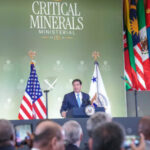
U.S. government officials have told Crisis Group that the Trump administration is invested both in securing raw materials for domestic use and in blocking Chinese access to minerals extracted from Venezuelan soil. To this end, in February, the U.S. launched Project Vault, a $12 billion critical minerals stockpile, aimed at protecting supply chains from foreign shocks. The Trump administration convened a rare earths summit on 4 February, including 54 countries and the European Commission, to discuss secure supply chains that do not include China. Washington has also announced major investments in domestic rare earth production and processing capacity, including a $400 million equity investment in MP Materials in July 2025, a $1.6 billion investment in USA Rare Earth the next January, and additional deals with companies such as Vulcan Elements and ReElement Technologies to refine rare earths and build specialised magnets. Because these companies focus on processing the minerals, the U.S. will still need to secure reliable sources of raw material, such as those found in Venezuela.
There is little doubting the interest of U.S. officials in a larger, better shielded supply of critical mineral and rare earths. Much as Venezuela seems open to U.S. business, however, its mining zones are not an easy environment in which to work. Mining areas lack even the most basic physical infrastructure, such as inland ports and roads to transport critical mineral ore in bulk. Current Venezuelan law also bars international arbitration, mandates sales to the Central Bank and requires that all foreign firms partner with Venezuelan state companies, which are riddled with corruption or exist only on paper. Assuming new extractive projects follow the law rather than the laissez-faire ethos that has predominated in recent years, the Venezuelan constitution also requires that firms consult with Indigenous groups whose territory would be affected and carry out socio-environmental impact assessments. Given the environmental damage mining can cause, rigorous and truthful analyses would likely rule out many operations.
Furthermore, many of these mines are controlled by Colombian rebel groups, including the National Liberation Army (ELN) and the Segunda Marquetalia, a group led by members of the former Revolutionary Armed Forces of Colombia (FARC) who reneged on the 2016 peace agreement signed by the guerrilla organisation. (Both groups have been designated as Foreign Terrorist Organisations by the U.S. Department of State.) The presence of the ELN, in particular, would cause problems for companies attempting to operate in Venezuela’s south. The rebels are active in the region’s borderlands and mining territories. Moreover, having pledged to defend Venezuela from U.S. invasion, the group would likely violently resist efforts to remove their control of mining operations and nearby communities, even if the effort had the Venezuelan government’s blessing. The ELN could use explosives to damage oil pipelines or engage in other infrastructure sabotage, as they have frequently done in Colombia when their political demands go unmet or extortion fees go unpaid.
Competition between armed groups further complicates the working environment.
Competition between armed groups further complicates the working environment. In the Venezuelan state of Amazonas, the ELN is locked in active combat with the Segunda Marquetalia. The latter has reportedly gained coercive powers over new so-called Indigenous guards groups, subverting a legitimate tradition of community-based territorial defence and forcing unarmed civilians to protect mining areas, including sites where critical minerals are extracted. If the Venezuelan military were to attack the rebel groups, armed outfits could follow a playbook they have employed previously and mobilise local populations as human shields.
State forces are deployed across the region, but not to protect miners or neighbouring communities. Witnesses report that helicopters arrive often, at times carrying apparent ELN members and people they described as “Chinese” buyers. Locals say state forces collect kickbacks at various points along the supply chain and, in some cases, they are directly involved in moving material. This complicity and mutual enrichment between armed groups and security officials would complicate any effort by Caracas to push back against illicit control of the mining sector.
Could oil and minerals help kickstart Venezuela’s economic recovery?
Venezuela’s path to economic recovery will require tapping its natural resources. As noted above, modest improvements to the country’s oil output could be made over the next two years, but rebuilding the industry will take much longer. Developing its mining sector will also require a longer-term effort. Current extraction patterns enrich armed groups and devastate Indigenous territories, while corrupting and undermining state institutions. Transforming minerals from conflict drivers into sources of sovereign wealth will require fundamental changes.
One path forward in the short term may lie in the formalisation of community-controlled mining. Small-scale extraction under local governance could generate cash and limit environmental damage. In order to stave off armed coercion, this effort would need to be limited in scope. But it could provide a reliable trickle of minerals. To get there, Caracas would need to legalise small-scale and community-led cooperatives, provide them with technical assistance, and establish direct revenue-sharing mechanisms with the state to bypass corrupt intermediaries.
Building transparent supply chains is also important. Minerals need to be traced from the mine site to refiners. Authorities could deploy existing international conflict mineral procedures: these involve building a certification scheme that tracks the product’s route from its origin mine to the buyer, with regular independent audits. If they do not adopt due diligence measures, U.S. companies risk becoming stuck between two bad options: they could extract directly and either provoke the ire of armed groups or collude with them; or they could buy from state companies responsible for financing systematic abuses of Indigenous and local communities.
The most challenging obstacles to responsible mining may be Venezuela’s own state authorities and security apparatus. The Rodríguez government may support opening the extractive sector to foreign investment, but Venezuelan security forces benefiting from opaque mineral supply chains would likely resist losing their current income stream, which is largely generated through kickbacks and extortion. Factions within the military, officials at national and local levels, and intelligence services profit from illegal mining, controlling extraction or receiving payments from armed groups that traffic them. Any genuine, effective regulatory framework would threaten these revenues, creating powerful incentives to sabotage reform regardless of political directives from Caracas. In theory, trusted security forces would be indispensable to protect any mining project from armed groups, particularly small enterprises led by local cooperatives, which lack the kind of resources multinationals can devote to keeping their investments and people safe. Yet at the moment, no such police force exists. The hard work of reforming the security forces may prove a necessary step in reactivating a strong, crime-free mining sector.
Rehabilitating the country’s petroleum industry, on the other hand, will require an overhaul of how the government has tapped Venezuela’s primary natural resource over the past two decades. PDVSA will have to regain talent lost to brain drain and make major investments in infrastructure and maintenance. It is likely that Washington will want to be closely involved in this restructuring. Partnering with foreign oil companies could put Venezuela back on the path to shipping millions of barrels a month – albeit over a long period. Major oil companies will certainly expect stability and promises to adhere to the rule of law before plunking down the billions of dollars this endeavour would require.
More importantly, leaders should work to ensure that the proceeds from oil sales are distributed equitably to the benefit of all Venezuelans. Chávez was able to rise to the presidency in 1998 by promising to break the stranglehold a small elite held over Venezuela’s wealth. Future political leaders should learn from the mistakes of past administrations and not forget that gross inequality – particularly in a country so rich in natural resources – is a fast track to public outrage and political upheaval.
Research on critical minerals was conducted by Amazon Underworld, a journalistic initiative led by Ebus.
More for you
How the World Sees the U.S. Raid in Venezuela
Also available in Español
Venezuela after Maduro: Transaction or Transition?
Also available in Español
