

Curtain Falls on Bangladesh’s Interim Government as Critical Elections Approach
emactaggart
Curtain Falls on Bangladesh’s Interim Government as Critical Elections Approach
What is happening?
Up to 127 million Bangladeshis will go to the polls on 12 February, in the first national elections since Prime Minister Sheikh Hasina’s government fell in August 2024. For tens of millions of them, it will be the first chance in their lives to participate in a credible vote. During her fifteen years in power, Hasina oversaw three flawed polls: the opposition boycotted two of them, in 2014 and 2024, and the third, in 2018, was widely seen as rigged. In those days, with the economy growing strongly, Hasina’s democratic failings seemed to matter little to many Bangladeshis. But her popularity began to wane around the time that the virus causing COVID-19 spread, as citizens started to discern the links between economic mismanagement, growing authoritarianism and worsening corruption. Public discontent with Hasina’s misrule laid the foundations for her ouster by a student-led popular uprising.
The elections mark the final step in the delicate political transition that has been under way for a year and a half. The trigger for the movement that led to Hasina’s downfall was the Supreme Court’s decision in June 2024 to revive job quotas for the descendants of “freedom fighters” in the country’s 1971 liberation war – an initiative widely seen as favouring supporters of her party, the Awami League. Hasina first tried to crush the protests denouncing this measure, but her regime’s violence only spurred more anger, turning the demonstrations into a mass movement demanding the government’s resignation. On 5 August, the Bangladeshi army, which until then had been regarded as a pillar of Hasina’s rule, refused orders to open fire on unarmed protesters who were closing in on her residence, leaving her with no choice but to flee to India, where she remains. Overall, as many as 1,400 people are thought to have been killed in the unrest, most by state forces and the Chhatra League, the Awami League’s student wing.
Following negotiations among the army, student leaders and political parties, an interim government led by Nobel laureate Muhammad Yunus was sworn into office on 8 August 2024. Yunus quickly outlined his agenda: initiate major political, economic and institutional change; prosecute those responsible for violence during the protests; and organise free and fair elections. The government re-established the International Crimes Tribunal (ICT) – a domestic judicial body first formed in 2009 to investigate crimes committed during the 1971 war – to try those allegedly responsible for serious abuses under Hasina’s regime. It also formed six reform commissions focused on areas considered critical, such as the constitution, election system and judiciary. These steps culminated in a ceremony in October 2025, when most of the country’s political parties signed the July Charter (so named after the month when the uprising against Hasina began), an agreement on a set of reforms the next government is expected to make.
The interim government has not been without its critics, who argue that it has waged a vendetta against the Awami League, failed to restore security and been too accommodating toward far-right Islamist groups, among other things. But it has managed to shore up a cross-party political consensus (excluding the Awami League), helping it reach agreement on the July Charter. Its final task will be to make a smooth exit from Bangladesh’s political scene by ensuring credible, peaceful polls, then transferring power to a democratically elected administration.
What are the main political forces taking part in the vote?
The electoral playing field will be marked by the absence of one of Bangladesh’s two largest political forces, Hasina’s Awami League. In May 2025, citing security concerns, the interim government temporarily banned the party’s activities until the ICT had reached decisions in cases against the party and its leaders for their alleged role in the violence against protesters the preceding July and August. The election commission also suspended the party’s registration. In November 2025, the ICT convicted Hasina of crimes against humanity in absentia, sentencing her to death. The troubling consequence of the Awami League’s absence is that millions of its supporters have, in effect, been disenfranchised. Thousands of Awami League supporters have also reportedly been detained, some under anti-terrorism laws.
The vote will still be hotly contested, however, with two main blocs fighting it out: one led by the Bangladesh Nationalist Party (BNP) and the other by Jamaat-e-Islami. The BNP is historically one of the two largest parties and the Awami League’s main rival. Last in power from 2001 to 2006, it has a wide network of activists and broad public support. But its reputation has suffered over the past year, due in part to the widely held perception that its grassroots members are involved in extortion and other criminal rackets. Internal conflict over candidate selection has reinforced a sense among disaffected Bangladeshis that the BNP is focused on money and power, making it little different from the Awami League. As several people put it in interviews with Crisis Group, many think the parties are “two sides of the same coin”. Party leaders have tried to counter this sentiment by expelling thousands of members for disciplinary breaches, but it may be an uphill battle.
Two recent developments may work in the party’s favour, however. On 25 December 2025, acting party leader Tarique Rahman returned to Bangladesh from the United Kingdom after seventeen years in self-imposed exile. His first speech back on Bangladeshi soil drew large crowds and swept negative coverage of the party from the front pages. Just five days later, his mother, two-time prime minister Khaleda Zia, died in a Dhaka hospital after years of poor health. Her namaz-e-janaza (funeral prayers) brought the capital to a standstill; the huge crowd of mourners included not only BNP supporters, but also many ordinary people who had come to pay their respects to one of the country’s most prominent political figures since independence.
The BNP’s prospects will depend on whether [Tarique Rahman] can bring the party together and enhance its appeal to disillusioned younger voters.
Whether these events translate into support for the BNP at the ballot box is far from assured. Tarique Rahman does not yet have his mother’s public following, and critics point to his alleged corruption when the BNP was last in power. Having run the party from exile for the best part of a decade, he remains only partially tested in the demanding world of Bangladeshi politics. The BNP’s prospects will depend on whether he can bring the party together and enhance its appeal to disillusioned younger voters.
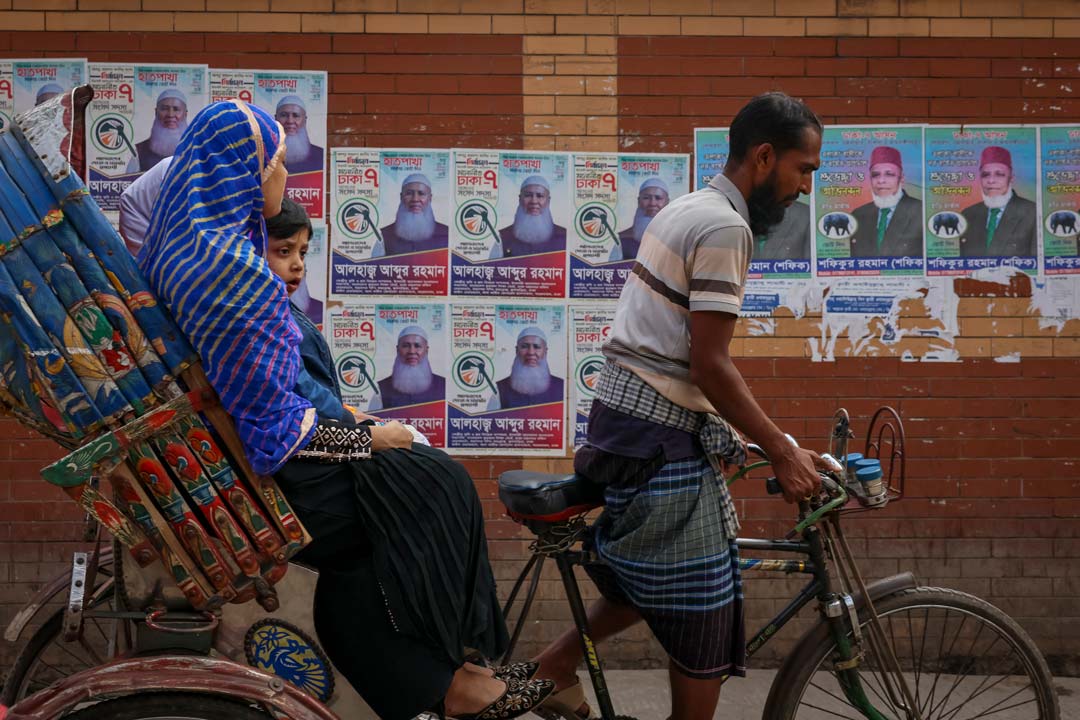
Jamaat-e-Islami, the other main contender, is Bangladesh’s largest Islamist party. Heavily persecuted under Hasina, Jamaat has been the big winner from the 2024 protest movement, in which its student wing played an important role. Party leader Shafiqur Rahman has emerged as one of the country’s strongest political performers, and the party’s social media campaign is unrivalled. While the perceived resurgence of Islamism in post-Hasina Bangladesh has received considerable media attention, Jamaat often appeals to voters despite, rather than because of, its ideology; most Bangladeshis practice a moderate, syncretic form of Islam unlike Jamaat’s stricter, more literalist one. Nevertheless, it appears that the party is gaining popularity among younger people, many of whom are less concerned about its controversial role during the Bangladeshi independence movement in 1971, when it sided with occupying Pakistani troops and members participated in mass atrocities against civilians. Today, some increasingly see Jamaat as an alternative to traditional politics, which they feel has mainly served the interests of a political and business elite. With a strong focus on social welfare, and a reputation for discipline and relative probity, Jamaat appears to fit the bill. In late 2025, the party’s student wing swept union elections at several universities, including the usually left-leaning Dhaka University – a previously unimaginable prospect.
Jamaat has been strengthened further in recent weeks by an electoral alliance with the National Citizen Party (NCP), the party formed in 2025 by students who were at the vanguard of the movement to oust Hasina. The NCP had hoped to become a powerful force in its own right, but it struggled to unify its disparate ranks behind a single clear set of ideas. As the election drew nearer, leaders realised that unless they aligned with one of the major parties, they were unlikely to win more than a handful of seats. They subsequently set out to create a bidding war between the BNP and Jamaat, which the latter won by offering more seats to the NCP. Cooperating with the Islamists has proven controversial within the NCP, with dozens of prominent party members quitting in protest. While the deal might boost the NCP’s chances in the election, it could prove a hindrance in the long term; the party risks being seen as a Jamaat affiliate rather than an entity in its own right.
Predicting the outcome of the 12 February poll is challenging because the electoral landscape has shifted so much. In the December 2008 election – considered the last credible one in Bangladesh – the Awami League got almost 50 per cent of the popular vote. While its backing has undoubtedly weakened since, it still has millions of supporters across the country. Which party these people decide to vote for – if they vote at all – will have a major bearing on the result, particularly in Bangladesh’s first-past-the-post system. Recent polling suggests that the BNP has a narrow lead over Jamaat. Regardless, Jamaat seems on track to surpass its previous best performance in 1991, when it secured eighteen seats with about 12 per cent of the vote.
How much progress has the interim government made on Bangladeshis’ demand for reforms?
Bangladeshis had high expectations of the interim government, which remained popular for some time, though it has lost some of its lustre of late. Yunus and his cohort have chalked up major achievements, including stabilising an economy that had been teetering under Hasina and maintaining a fragile consensus on the course of the transition with the army and political parties.
Their signature achievement as regards reform has been to oversee drafting the July Charter. All the political parties agreed on the need for change, but not necessarily on which measures to take or in what order. It was nonetheless important for the interim government to seek buy-in from all the parties contesting the vote, since making these reforms will be the responsibility of the incoming government. Yunus and his cabinet succeeded, but with caveats.
The process of drafting the Charter began in September 2024, when Yunus formed six reform commissions that reported back a few months later with recommendations. These were compiled into a shortlist and a National Consensus Commission negotiated with the political parties over which new policies to adopt. The interim government had hoped the parties would sign the Charter in early August 2025, around the anniversary of Hasina’s downfall, but disputes over both content and procedure delayed the ceremony to late October. In the end, 25 parties signed on, including the BNP and Jamaat.
The final July Charter is composed of 84 proposals, including 48 related to the constitution. Advocates argue they will serve as guardrails to keep institutional rebuilding on track and protect democracy in the meantime. Proposed changes include reducing the prime minister’s power, strengthening the opposition’s oversight role in parliament, making it more difficult for any one party to amend the constitution – no matter how large its parliamentary majority – and diluting partisan influence over judicial appointments. About five parties refused to sign the July Charter, chief among them the NCP. Even so, its concerns are centred around implementation rather than content, and it has since said it would support the reforms. More importantly, some of the signatories – notably the BNP – issued “notes of dissent” on some points in the Charter, sowing doubt as to whether they would proceed with the reforms in question if elected. The BNP said it objected to at least nine sections, including the introduction of proportional representation in the new upper house of parliament.
The interim government found a workaround of sorts. In mid-November, it issued an implementation order outlining the next steps, including a referendum on the July Charter to be held concurrently on election day. The order represented a compromise between the demands of the BNP (and a few allies) and those of the remaining parties that negotiated the Charter. A crucial decision was to formulate the referendum question so that, if it succeeds, proportional representation would be introduced in the new upper house, despite the BNP’s objections. Whoever controls the lower house would likely need to negotiate with other parties to get amendments through the upper chamber – unlike Hasina, who after her landslide 2008 election victory pushed through constitutional changes without consultation.
Even if the referendum were to fail, the winning party would still feel pressure to implement the parts of the July Charter that it supported.
The BNP is unhappy at being forced into some of these changes, but it has said it will support a yes vote; the party is desperate not to be portrayed as “anti-reform”. Yunus and the interim government are also campaigning strongly for a yes vote. Even if the referendum were to fail, the winning party would still feel pressure to implement the parts of the July Charter that it supported. The BNP has its own 31-point reform plan, which covers some of the key points in the Charter, so a degree of constitutional change is likely no matter what. Many observers nevertheless remain sceptical as to whether the reforms will really change much about Bangladeshi politics, as in the past political parties have tended to backtrack on promises of sweeping change once they get into power.
The interim government has also attempted reforms itself, but its record is patchy. On the economic front, it has, together with the central bank, begun making changes in the banking sector, which was looted by Awami League cronies, and awarded operating contracts for several ports to major foreign companies, which could help overcome logistical bottlenecks. The next government will need to continue with sensible macro-economic management, reduce the reliance on the garment industry (which accounts for 80 per cent of total exports), create more jobs and win the confidence of local and foreign investors. The interim administration also took steps to bolster judicial independence, including changes in how judges are appointed and transferred.
In other domains, there is less progress to report. Despite its importance, the security sector remains largely untouched. The police force, which was used for partisan political ends under Hasina and implicated in violence against protesters, has not regained the public’s trust. Its weak standing has contributed to a growing trend of mob violence, particularly lynchings, as citizens take justice into their own hands; few of those responsible have been held to account. The interim government has also failed to reform the security agencies accused of carrying out abuses under Hasina, such as the Rapid Action Battalion and Directorate General of Forces Intelligence, focusing instead on prosecuting individual officers.
Certain reforms, meanwhile, have fallen by the wayside. The Women’s Affairs Reform Commission was targeted for criticism by conservative Islamist groups and few of its recommendations have been adopted. The head of the Media Reform Commission has also complained that the government has not acted on any of the 100-plus recommendations it put forward. It is not entirely clear whether these failures were due to the interim government’s struggles to act on so many issues at the same time or whether it simply lacked the resolve to overcome public or institutional resistance. But increasing numbers of Bangladeshis seem to believe that the interim government has failed to live up to its lofty ambitions on the reform front.
Are the elections likely to go smoothly?
The biggest risks revolve around security in the run-up to and during the polls. Historically, political violence in Bangladesh has tended to increase around competitive elections. Bangladeshi human rights groups have already documented an uptick since August 2024. Recent months have witnessed clashes between BNP and Jamaat partisans, and more could flare up in hotly contested districts. In Awami League strongholds, given the ban on the party, supporters may resist attempts by rivals to campaign, as occurred when the NCP staged a rally in Hasina’s hometown of Gopalganj in July 2025, leading to at least three deaths. Conflicts inside the BNP are another worry, with factions vying for control of local extortion rackets and other economic benefits. According to some human rights groups, intra-BNP squabbles have actually been the main source of political violence since September 2024.
The killing of Sharif Osman Hadi in mid-December has added to electoral tensions. A member of the student movement that toppled Hasina, Hadi shortly afterward co-founded Inqilab Mancha, a civil society group that lobbied for the Awami League to be banned. He had registered as an independent candidate in the election and was shot while campaigning on a busy street in central Dhaka. Many Bangladeshis believe that Awami League members were behind his murder. News of his death sent shock waves through the country, sparking often violent protests. As many Bangladeshis blame India for providing refuge to Awami League leaders, crowds attacked media outlets that some claim are pro-India, as well as New Delhi’s consulates in various cities. In one particularly heinous incident, a mob lynched a member of Bangladesh’s Hindu minority, prompting Hindu nationalist groups to demonstrate outside Bangladeshi diplomatic outposts in India.
There is a risk of further violence targeting those participating in the poll, as well as reprisals against Awami League supporters or Bangladesh’s Hindu minority.
Regardless of who was responsible for Hadi’s killing, it has put the country on edge, and left many Bangladeshi politicians concerned for their safety. At least sixteen politicians have been killed since the election schedule was announced in early December, most of them from the BNP. There is a risk of further violence targeting those participating in the poll, as well as reprisals against Awami League supporters or Bangladesh’s Hindu minority, who are generally considered loyal to Hasina’s party. As noted above, the election is also taking place at a time when the police force is seen as ineffective, and incidents of mob violence are on the increase. To maintain security in the days before and after the vote, the home affairs ministry says over 900,000 security personnel will be deployed, including police, paramilitary forces and more than 100,000 members of the army.
If the election result is contested in some way, it could spiral into a political crisis. For the past eighteen months, the interim government’s survival has depended on maintaining the political consensus between the army and major political parties. Yunus has had to make concessions to all sides to reach an agreement on reforms, opening the way to the 12 February elections. But given the stakes, managing a dispute over the outcome of the vote would be his biggest challenge yet. There is reason to hope for calm when the tallies are announced, however, as Jamaat insiders say they do not expect to win and instead view the poll as a stepping stone to the next elections in five years’ time.
What will be the main challenges facing the next government?
The 12 February elections are crucial for several reasons. The vote will not only return Bangladesh to a firm constitutional footing but also bring to office a government with a genuine popular mandate for the first time since December 2008. But the incoming administration will need to address a raft of challenges, from weak institutions to a sluggish economy heavily dependent on garment exports and remittances to the growing effects of climate change in one of the world’s most densely populated countries. It will also need to navigate tricky foreign policy issues, particularly relations with India, the implications of the intensifying U.S.-China rivalry and the lack of progress toward resolving the status of more than one million Rohingya refugees languishing in camps near the Myanmar border. There are also concerns over the growing influence of radical Islamist groups, such as Hizb ut-Tahrir, which have become more prominent since Hasina’s ouster, and the capacity of state forces to watch out for violent extremist activity.
Perhaps the most important threat to stability in the years ahead would stem from a failure to meet the aspirations of Bangladesh’s youthful population. Roughly half are under 30, and many struggle to find work that matches their education level, leaving a deep sense of frustration. Beyond job opportunities, Bangladeshi young people want to see their country run with greater integrity and the benefits of growth distributed more broadly. Any stumble in seeing through reforms, starting with the July Charter, would risk reinforcing a perception that the political change they were promised has been cosmetic.
The incoming government will also have to grapple with the thorny issue of political reconciliation. Given its prominence in the country’s history and its strong electoral base, the Awami League cannot remain on the sidelines forever. But the party’s actions under Hasina, particularly in July-August 2024, mean that allowing it to come back to the electoral arena, even under new leadership, will be politically fraught. A consensus among the main political parties and institutions on the conditions for the Awami League’s return in some form would help reduce the risks of the issue being a major flashpoint. For that to happen, however, the Awami League leadership would need to show genuine remorse for the violence it unleased on protesters in 2024, something Sheikh Hasina has so far refused to do. India and other foreign governments with influence could help broker dialogue between the party and the future government to come to an agreement.
An elected government with a five-year term will be better positioned to manage the country’s political rancour and social and economic challenges than an interim administration, but the tasks at hand are many and complex. Foreign governments, many of which have cheered on Yunus and his colleagues, should extend support to the incoming government as it seeks to turn the page on Bangladesh’s recent turbulence.
